Credit Card Churning 101
Put $1,000 a month of groceries, gas and bills on one credit card, and it can put you in a Business Class seat from Toronto to London for $80. The cash fare is $6,636, so that is $6,556 saved on one ticket. That is credit card churning. Here is how it works, the four rules that keep your credit safe, and the three cards I would open first.
Let's start with why
Your credit card is a more powerful tool than you think. For me, it runs about half of my monthly spending: groceries, gas, the daily coffee, gifts, entertainment, the streaming subscriptions I keep meaning to cancel. You can even pay your rent through a credit card now (a post on that is coming).
A standard credit card gives you about 1% back. That's the floor I set for myself: if a card can't do 1%, it doesn't live in my wallet. But here's what I figured out after a few years of reading fine print: with a smarter strategy, that same spending can return 5%, even 10%, once you start doing proper credit card churning.
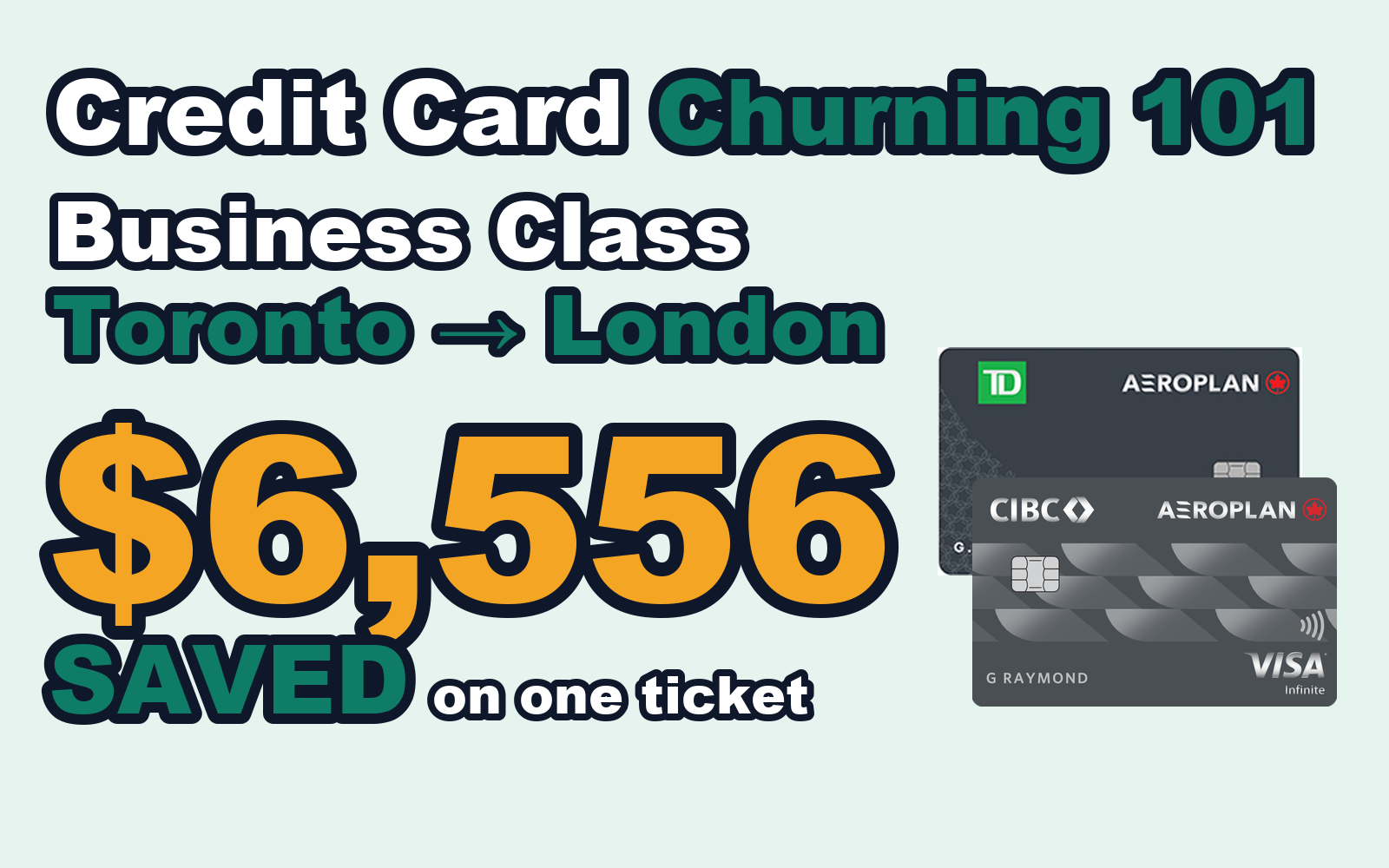
The whole post in one picture. The numbers are real and the receipts are below.
What the top end looks like
Let me show you the best case before the theory, because it is the reason this hobby exists.
The TD Aeroplan Visa Infinite is currently offering up to 50,000 Aeroplan points, with the first-year fee waived. To unlock all of it you put about $12,000 through the card over the year. That spending earns points too, roughly another 15,000 at the card's regular rates. Call it 65,000 points in the account, from money you were going to spend anyway.
On the day I wrote this, Air Canada wanted 65,600 points plus $80.41 in taxes for a one-way business-class seat from Montreal to London on October 17. The same lie-flat seat out of Toronto, paid in cash, was $6,636.
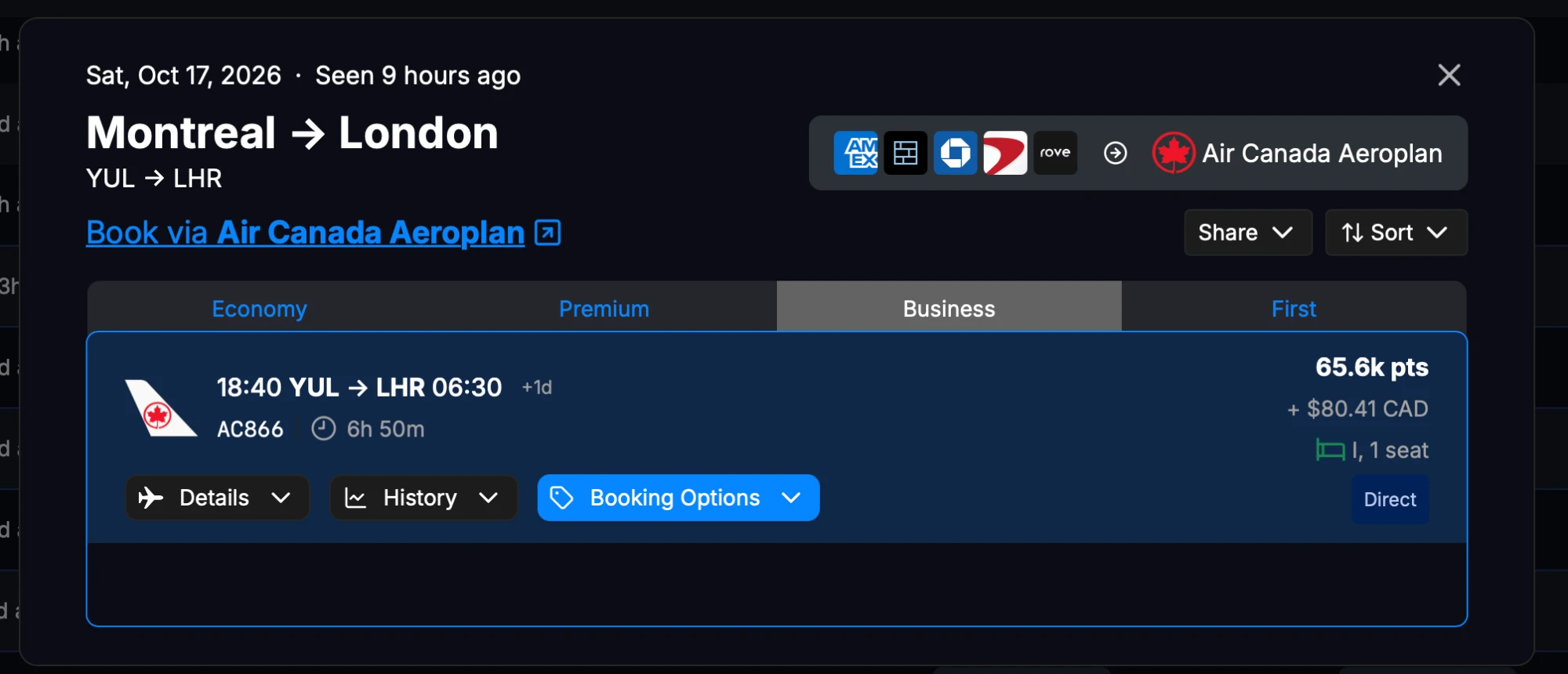
Award search for the Aeroplan booking, September 6, 2026. 65,600 points plus $80.41 in taxes for a lie-flat seat, one seat left.
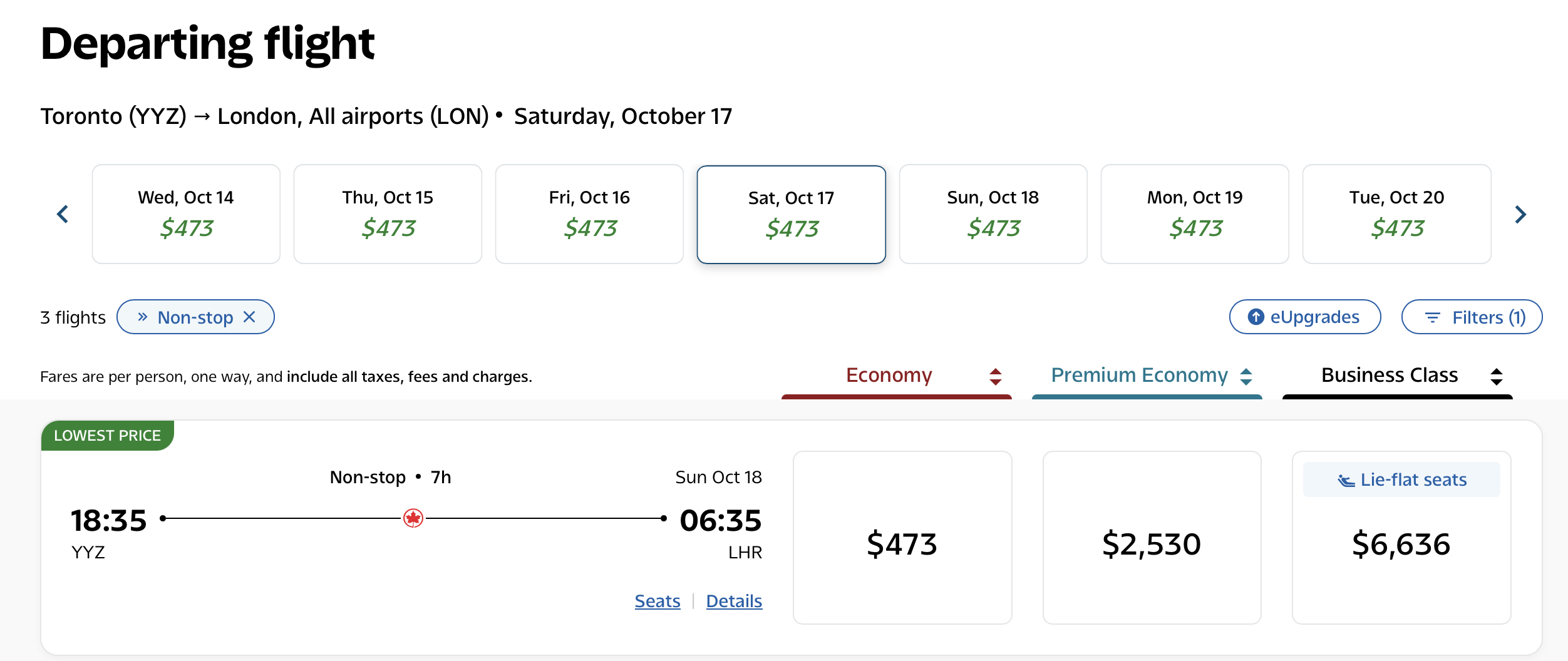
aircanada.com, September 6, 2026, for travel October 17. Fares are one way and include taxes. Look at the right-hand column.
So here is the math. $12,000 of everyday spending. $80 out of pocket. A $6,636 seat, which means $6,556 saved on one ticket. A plain 1% cash-back card would have paid me $120 on that same $12,000.
Two honest caveats, because that is the whole point of this site. First, this is the ceiling, not the average. Business class is where Aeroplan points are worth the most, about 10 cents each on this booking versus the 2 cents I use for planning everywhere else in this post. Second, it only counts as $6,600 if you would actually fly business class. If you would have bought the $473 economy seat, the honest value of those points is closer to $400, and you would be better off with a cash-back card. Either way, it beats $120.
So what is credit card churning?
Banks and financial institutions throw huge welcome bonuses at new customers. Why? Because they want to make money from you (a lot more on that in an upcoming post about how banks actually profit from credit cards). The bonus is the bait.
Take the BMO CashBack Mastercard. Right now it's offering 5% cash back for your first 3 months. Sounds great. We have better offers than this (more on that below), but it's a clean example of how the game works.
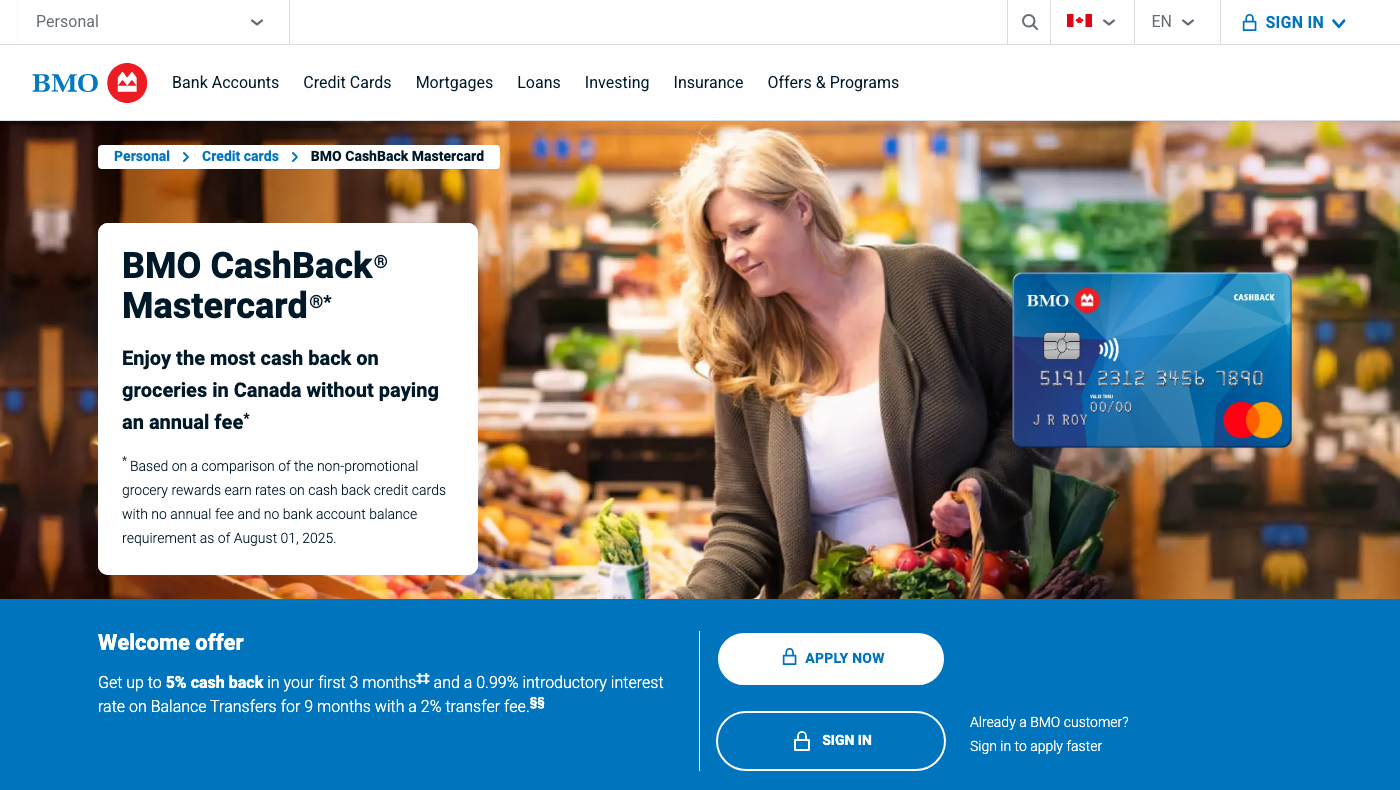
Screenshot from bmo.com, September 6, 2026. Look at that "5%" and then look at the tiny ‡‡ next to it. That symbol is where the real story lives.
Churning is simple in concept: open a card for the welcome bonus, collect it, then move on to the next one. Obviously we don't want to do all that work for three months of slightly better rewards. We want to be strategic and a little lazy: put in as little time as possible, but still walk away with a meaningful pile of cash or points. That's exactly what this post is about.
Churning 101: know what you want, do the math, ignore the slogan
Before you apply for anything, answer three questions:
- What do you actually want? Cash in your account? Aeroplan points for a business-class seat? Something you can spend anywhere? Pick one. A "10% back" card is useless if the 10% is on something you never buy.
- What's the real return? Not the headline. The dollars you pocket, after the annual fee, after the caps, on the spending you'd do anyway.
- How much effort do you want to put in? Some people love juggling five cards. Some want one card and zero thinking. Both are fine, but be honest about which one you are.
And please, don't get fooled by the marketing slogan. "5%" or "10%" sounds like a lot. In reality, those rates almost always apply only to your first few hundred dollars of spending. Here's what that ‡‡ footnote on the BMO page actually says, in plain English:
- The 5% applies to your first $2,500 of spending: $500 on groceries, $500 on recurring bills, and $1,500 on everything else.
- Maxed out, that's $125. Total. That's the ceiling.
- Against a 1% baseline, you would have earned $25 on that $2,500 anyway. So the offer is really worth about $100 extra, roughly a 4% bump on a small slice of spending.
I'd rate that a third-tier welcome offer. Not bad for a no-fee card, but nowhere near the good stuff. For comparison, the Aeroplan card I'll mention below hands you about $1,000 in flights in year one, with the annual fee waived. Same amount of paperwork, ten times the payoff. That's why we do the math.
Things to be aware of before you start
1. Opening a new card dings your credit score in the short term. Every application is a hard inquiry, and your average account age drops. So don't open five cards at once. Space them out (I like roughly 90 days apart). On top of that, almost every welcome offer comes with a minimum spend you have to hit within a window (usually 3 months). If you open two cards at the same time, you have to spread your spending across both and still clear both hurdles. That's how people end up buying junk to chase a bonus, and that's how the bank wins. I'll write up how I hit minimum spends without spending a dollar extra in a separate post.
2. Annual fees are the enemy. First-year waivers are your friend. A lot of the best cards charge $120 to $150 a year but waive it for the first year. The play is to take the bonus in the fee-free year, then, right before the year-two fee posts, either downgrade to the no-fee version of the card or cancel it. In practice this means you'll be rotating your card lineup once or twice a year. More on when a fee is actually worth paying in a later post.
3. Always pay your card in full, on time. I can't say this enough. Banks make their credit card money from people who don't pay in full. Those people are literally subsidizing your fat rewards. Credit card interest runs 20 to 25%, which makes it the worst loan you will ever take. Carry a balance for one month and you've wiped out the entire bonus. If you're not confident you can pay in full every month, churning is not for you yet. Fix that first. (I'll break down the bank's whole revenue model in a separate post.)
4. Will churning wreck your credit score? Short answer: no. But that "no" rests on two conditions. First, you pay on time, every time (see point 3). Second, you keep your credit utilization low. If you have $10,000 in total limits across all your cards, try to keep your balances under 30% of that, so under $3,000 at any statement. Here's the fun part: opening a new card actually helps here, because more total limit means a lower utilization rate for the same spending. Short-term dip from the inquiry, long-term boost from the extra room. The one exception: don't open new cards in the year before you apply for a mortgage.
The cards I'd look at first
This post is already getting long, so I'll save the full "here's exactly which cards I churn and in what order" for a follow-up. But if you want to start now, these are the three I'd point you at:
| Welcome offer (as of Sept 6, 2026) | Annual fee | Who it's for | |
|---|---|---|---|
| CIBC Aeroplan Visa Infinite | Up to 50,000 Aeroplan points (≈ $1,000 in flights) | $139, waived year one | Anyone who flies |
| TD Aeroplan Visa Infinite | Up to 50,000 Aeroplan points | $139, waived year one | Same, if you'd rather bank with TD |
| CIBC Dividend Visa Infinite | Up to $350 (10% back on your first $2,000, plus fee rebate) | $120, rebated year one | Cash, not points |
| Amex Gold Rewards | Up to 60,000 Membership Rewards points | $250, not waived | Your one Amex shot |
1. Aeroplan: the CIBC Aeroplan Visa Infinite or the TD Aeroplan Visa Infinite. If you fly at all, and especially if a business-class seat is on your wish list, this is the best welcome offer in the country for the effort involved. Both cards are free for the first year and both are currently dangling up to 50,000 Aeroplan points, which is roughly $1,000 in flights if you redeem them properly. Both earn 1.5x on groceries and gas, so the everyday earn is respectable too. I'd churn the CIBC one first, then come back for TD. A full breakdown of every Aeroplan card in Canada is next on my list.
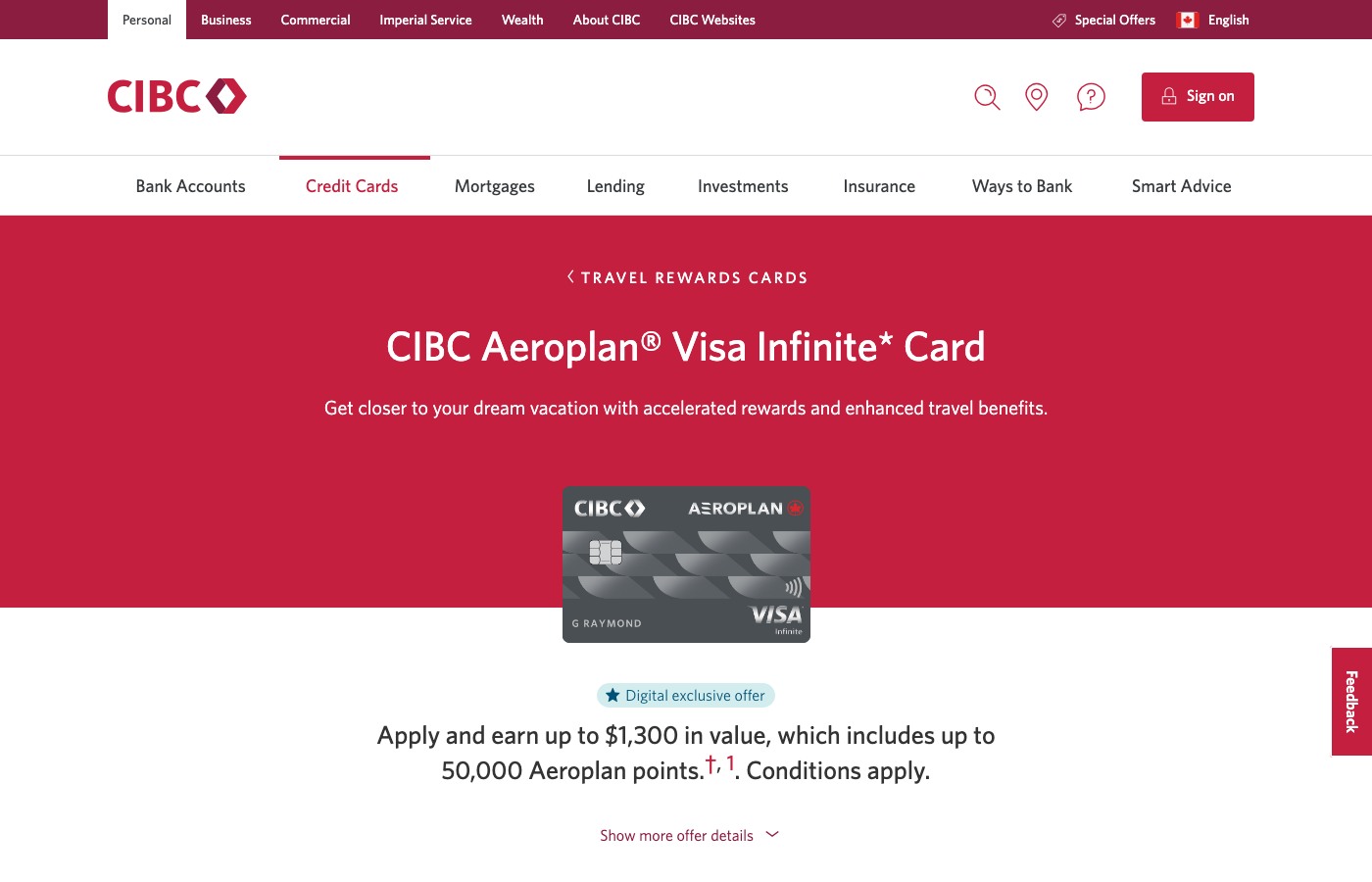
cibc.com, September 6, 2026. "Up to $1,300 in value" is the bank's number. Mine is about $1,000, because I only count the points and only at what they buy on a flight.
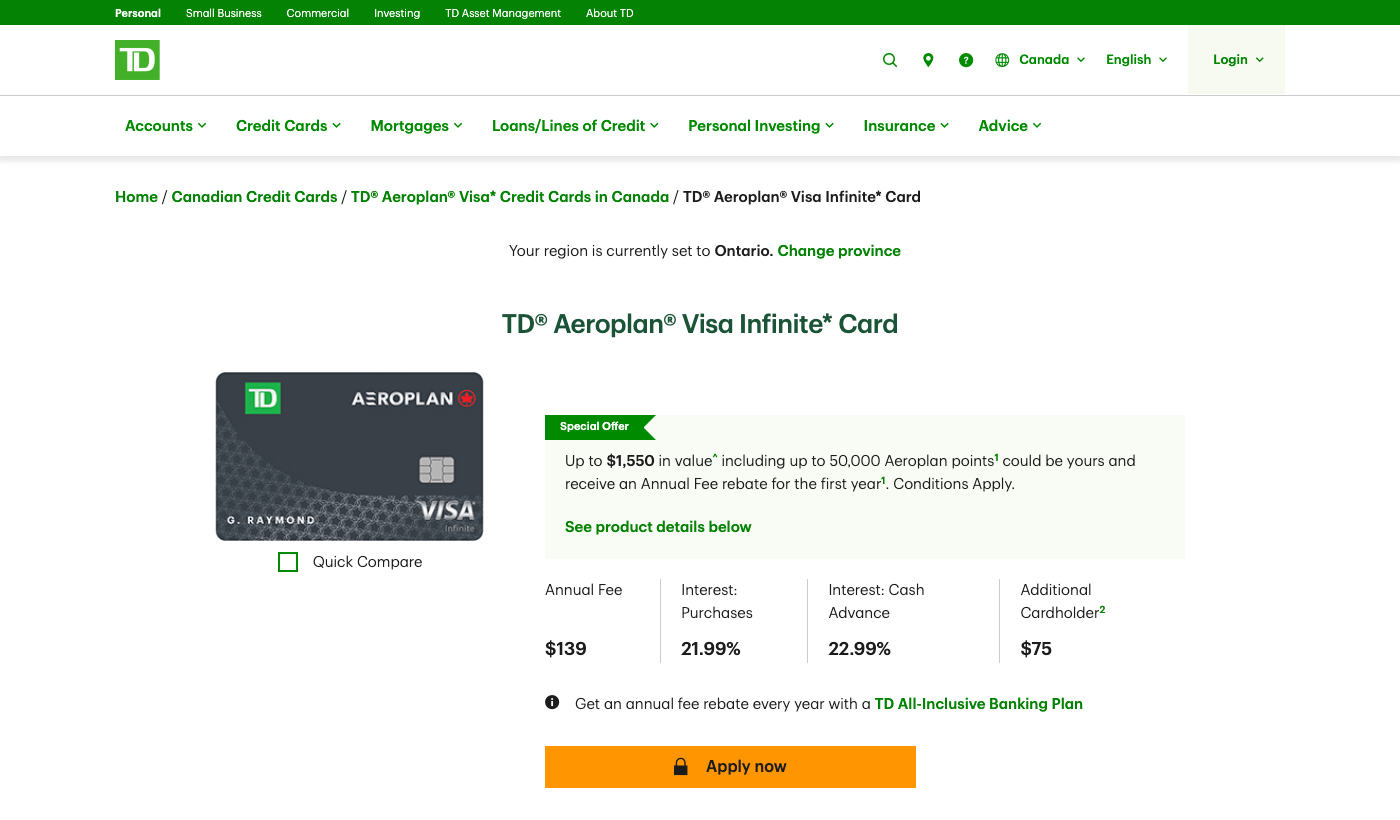
td.com, September 6, 2026. Notice the $139 fee, 21.99% interest and $75 for an extra cardholder right under the offer. That's the honest part of the page.
2. Cash back: the CIBC Dividend Visa Infinite. If you'd rather have money than points, this is my pick. The welcome offer is 10% cash back on your first $2,000 for four statements (up to $200), plus $50 for setting up one pre-authorized payment, plus the $120 fee rebated in year one, so up to $350 in total. The everyday rate is 4% on groceries and gas, which is why it's also the rare card worth keeping after year one. If you don't spend enough to justify the fee in year two, downgrade to the no-fee CIBC Dividend Visa and keep the account open. The full cash-back comparison is coming soon.
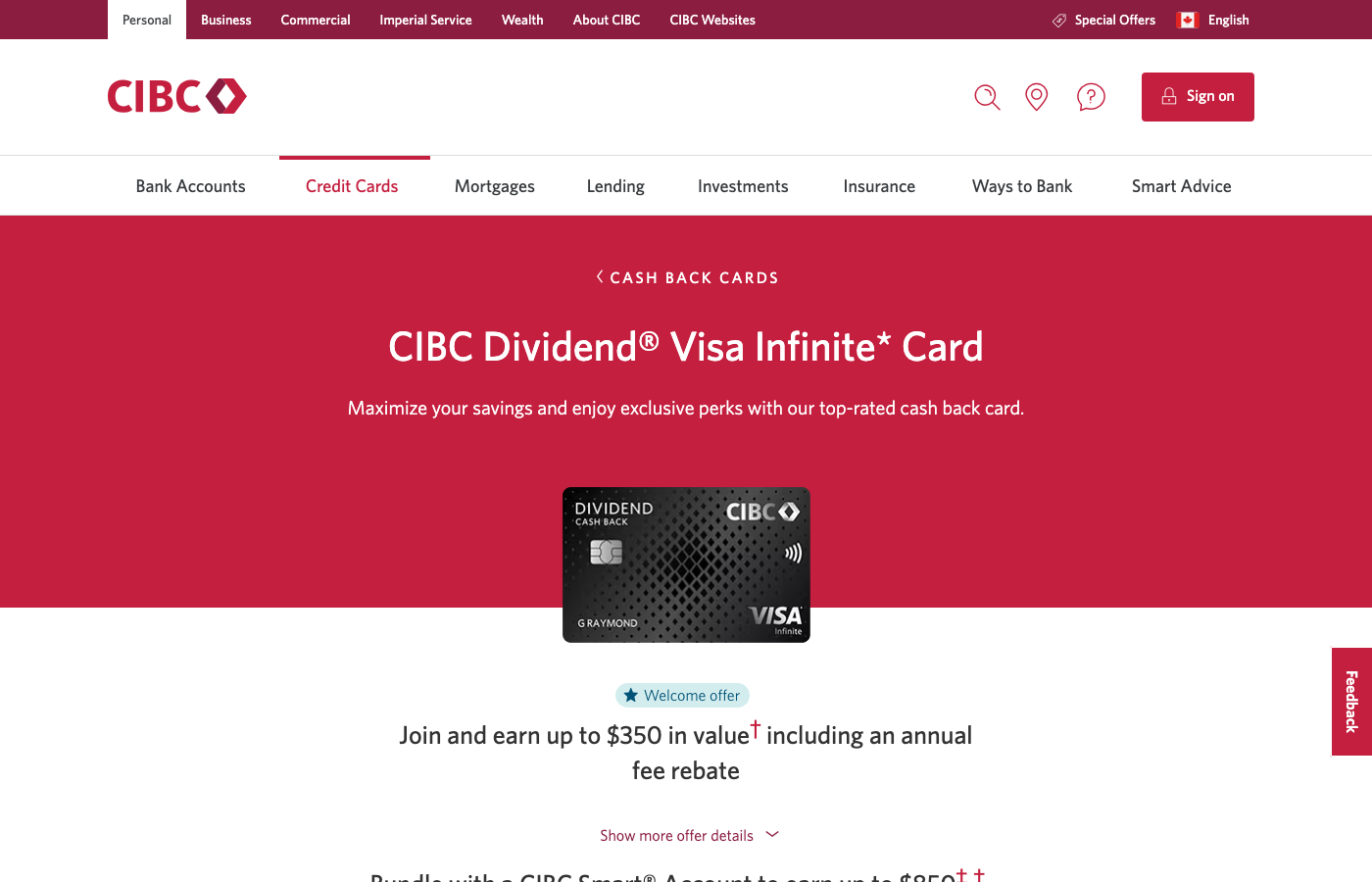
cibc.com, September 6, 2026.
3. Amex: the American Express Gold Rewards Card. Amex bonuses are once per lifetime per card, so you want to spend that one shot on a card that pays well. The Gold Rewards does: 5,000 Membership Rewards points every month you spend $1,000, for 12 months, so up to 60,000 points. Amex's own page values that at $600. I value it closer to $1,200, because Membership Rewards transfer 1:1 to Aeroplan, and Aeroplan points are worth about 2 cents each when you spend them on flights. Two catches: the $250 fee is not waived, and Amex isn't accepted at Costco or most Loblaw-banner grocery stores. Still a strong net. If you just want Amex cash back instead, the SimplyCash Preferred pays 10% for 3 months (up to $200) plus $50, but its fee isn't waived either. I'll cover how to squeeze the most out of Membership Rewards in its own post.
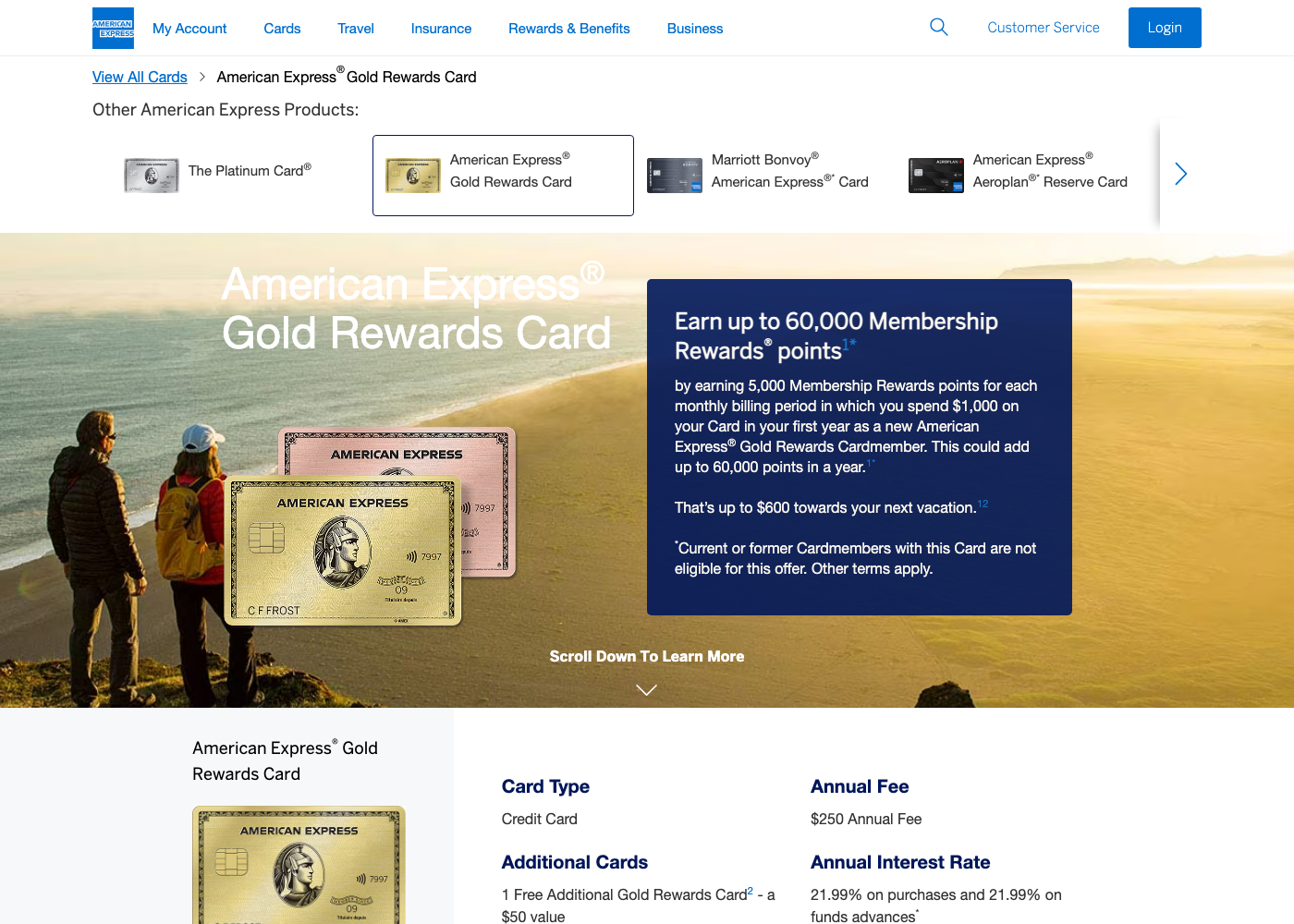
americanexpress.com, September 6, 2026. Read the small print in the blue box: "Current or former Cardmembers with this Card are not eligible." That's the once-per-lifetime rule in the wild.
Want the exact math?
If you want to see the actual returns on these cards, every dollar of spend, every fee, every cap, that's the next post. After that: which cards I churn and in what order, how I compare rewards programs in the first place, and how the banks make money off all of this. This is post one. Stick around.
Now go pay off your balance. Then we can talk. 💳
The honest fine print: Card details are from the issuers' official pages and cardholder agreements, cross-checked against independent trackers, and compiled in ../card-research/. Screenshots are of the public product pages on September 6, 2026 and belong to the respective banks and to Air Canada; the Toronto–London fares shown are one-way prices for October 17, 2026 as displayed that day, and award pricing is dynamic. The cover image is a text graphic of the same figures. Welcome offers change constantly and most have apply-by dates (the BMO CashBack Mastercard offer shown runs to October 31, 2026), so confirm the live offer before applying. Point values (~2¢ for Aeroplan and Membership Rewards) are a planning estimate for decent flight redemptions, not a guarantee. Opening and closing cards affects your credit, banks can claw back bonuses for obvious gaming, and Amex welcome bonuses are once per lifetime per card. This is general information, not financial advice, and there are no affiliate links here. The best card is the one that's best for you.