How Credit Scores Work
One late credit card payment can stay on your credit report for up to 6 years. The fix is boring: pay on time and keep your balances low. Here is how the whole system works.
Nobody explains this when you get your first card. This post covers what the number means, who keeps it, what goes into it, what doesn't, how long mistakes follow you, and the three myths I hear most. Every fact comes from the federal government's consumer agency (FCAC) or from Equifax, one of Canada's two credit bureaus.
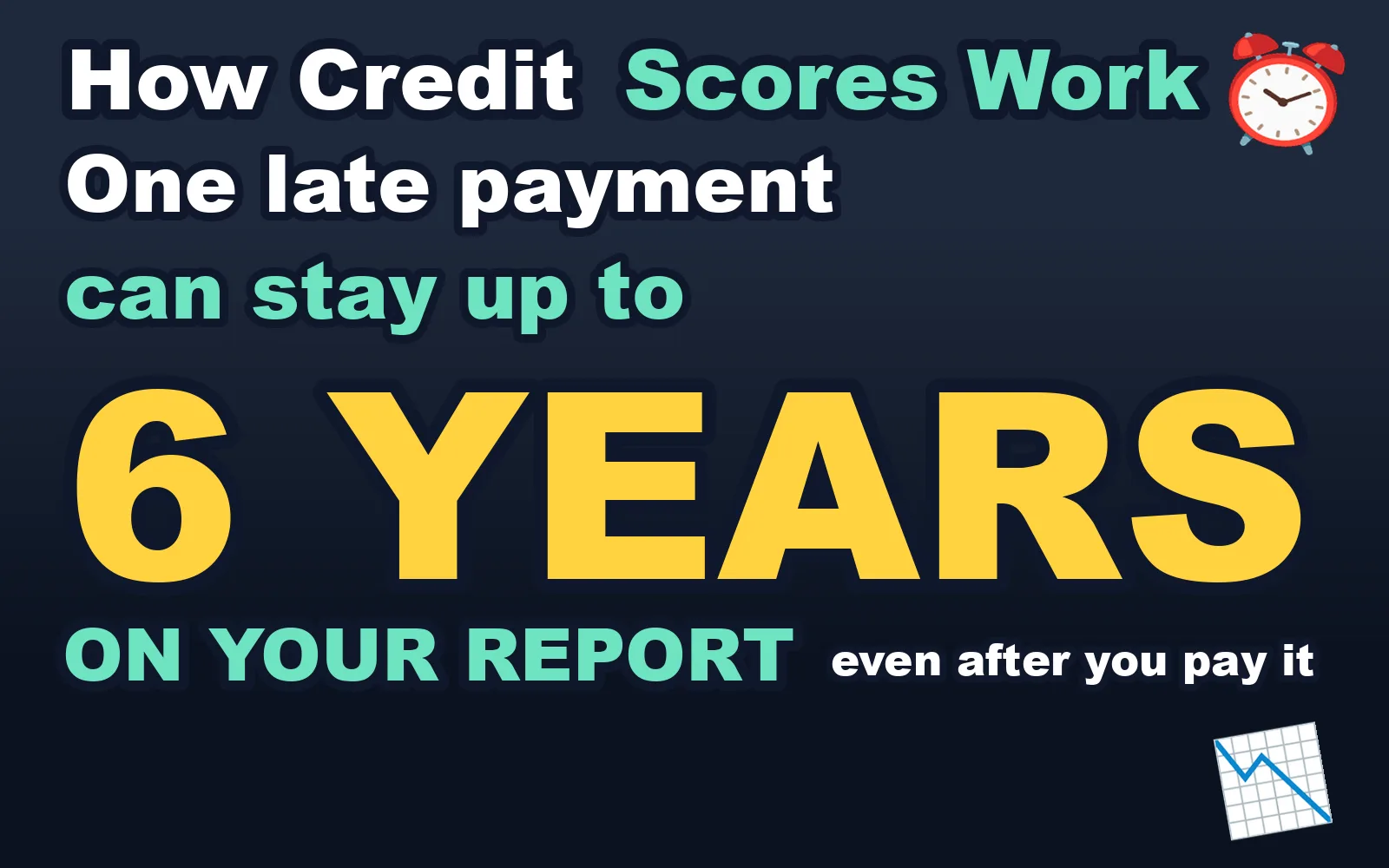
The whole post in one picture. The receipts are below.
The number: 300 to 900
Your credit score is a three-digit number that tells a lender how likely you are to pay back what you borrow. In Canada, scores "usually range from 300 to 900," according to FCAC, and higher is better.
Equifax puts rough labels on the range:
- 760 and up: excellent
- 725 to 759: very good
- 660 to 724: good
- Below 560: poor
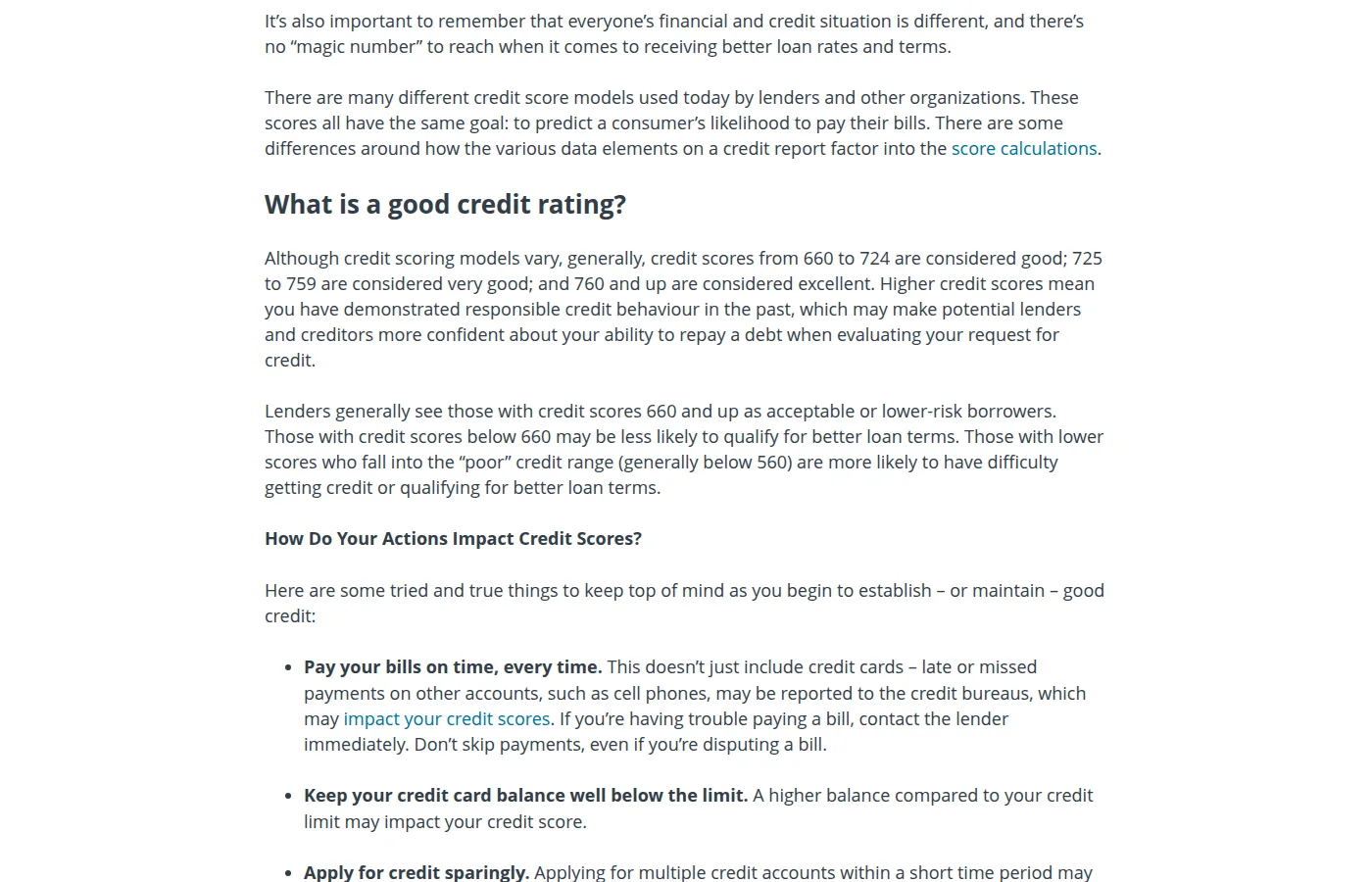
equifax.ca, November 1, 2026. The second paragraph is the useful one: lenders "generally see those with credit scores 660 and up as acceptable." Below that, better rates get harder to find.
Why it matters in dollars: lenders use your score to decide whether to lend to you, and at what interest rate. It shows up in places you wouldn't expect. To get an insured mortgage through CMHC with less than 20% down, at least one borrower needs a score of 600 or more.
Who keeps score: Equifax and TransUnion
Canada has two credit bureaus, Equifax and TransUnion. Every month, your card company and other lenders tell them how you used your accounts. That record is your credit report. Your score is a number calculated from it.
Three things surprise people:
- You have two reports, not one. Not every lender reports to both bureaus, and they don't report on the same day. So your two files can differ.
- You have many scores, not one. Each bureau runs several scoring formulas, and lenders can use their own. Equifax says it's "normal to see differences of 100 points or more" between scores.
- Your history from another country doesn't count here. The bureaus only track credit in Canada. If you just arrived, start with Building Credit as a Newcomer.
What goes into your score
FCAC says the bureaus "don't share the exact details" of their formulas. Equifax is the only one that publishes rough weights, and they line up with what everyone else says:
| What it measures | Weight | What it means for you |
|---|---|---|
| Payment history | ~35% | Did you pay at least the minimum by the due date, every time? |
| How much of your limit you use | ~30% | A $300 balance on a $1,000 limit is 30%. Lower is better. |
| Length of your history | ~15% | How long your accounts have been open. Time does this for you. |
| Credit mix | ~10% | Cards, loans, a mortgage. Never borrow just to improve this. |
| Inquiries | ~10% | How often lenders checked your file because you applied for credit. |
Two-thirds of the score is paying on time and not using too much of your limit. FCAC's advice is to "try to use less than 30% of your total credit limit," and to keep that usage low "even if you pay the full balance." Paying in full keeps you out of interest. It doesn't stop a high balance from showing up on your report.
What doesn't count
Equifax keeps a list of things that don't touch your score, and a few of them surprise people:
- Your income. A raise or a pay cut doesn't change it directly. Lenders ask about income on the application instead.
- Your debit card. You're spending your own money, so there's nothing to report.
- Your bank balance, RRSP and TFSA. Your report doesn't show your savings.
- Getting married. Your credit histories stay separate. Only joint accounts show up on both reports.
- Checking your own score or report. Check as often as you like.
- Being turned down. The "no" itself isn't recorded. The credit check from applying is, though (next section).
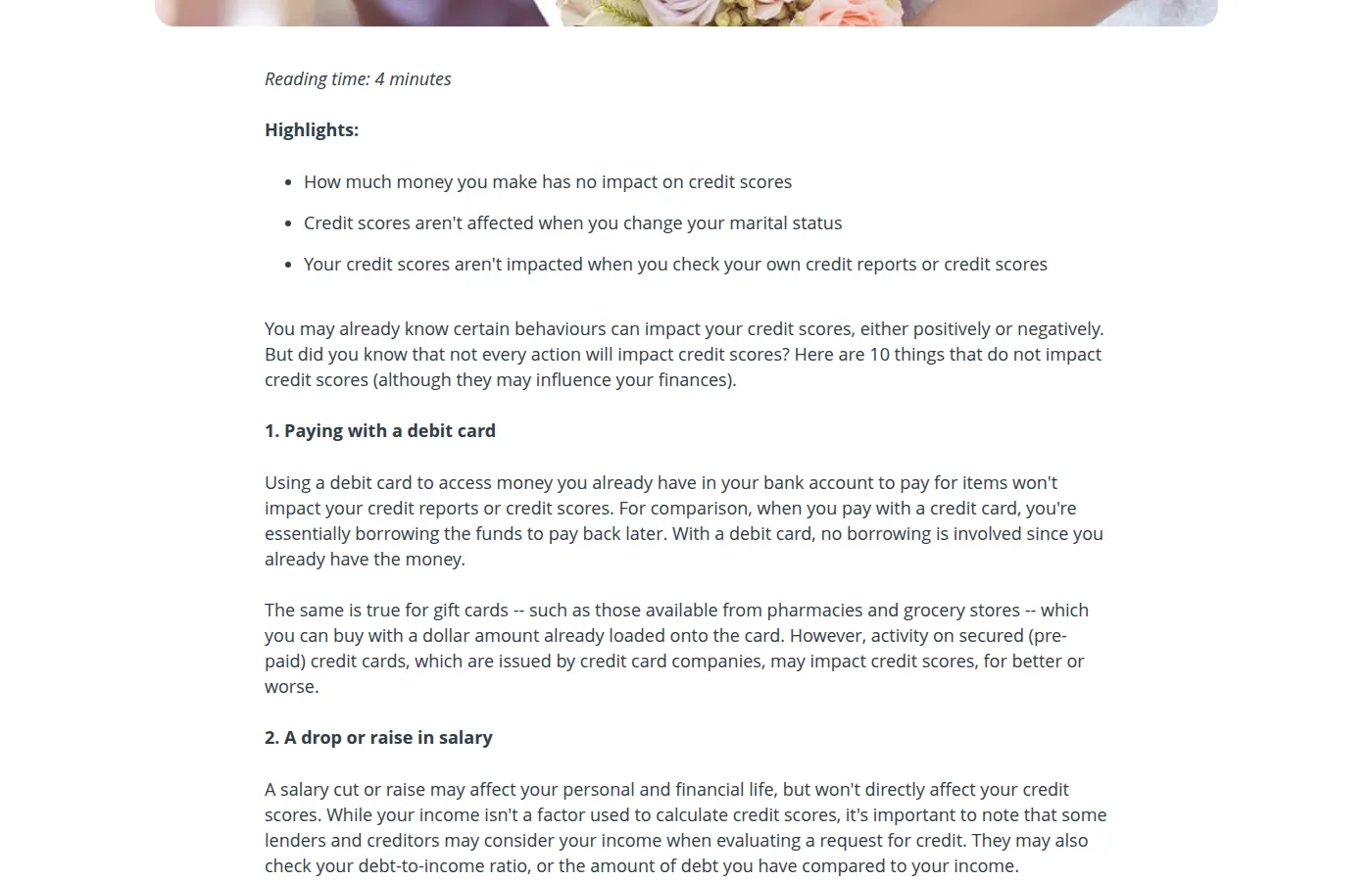
equifax.ca, November 1, 2026. The three highlights at the top are the ones worth remembering: income, marriage and checking your own score don't count.
Hard checks and soft checks
When a lender looks at your file, it leaves a mark called an inquiry. There are two kinds, and FCAC explains the difference:
- Hard inquiry: you applied for credit, like a card or a loan. Anyone who looks at your report sees it, and it can lower your score a little. It stays for 3 years at Equifax and 6 years at TransUnion.
- Soft inquiry: you checked your own score, or a company pre-screened you. Only you can see it, and it doesn't affect your score.
One exception helps people shopping for a big loan. If you get several car loan or mortgage quotes within about two weeks, the bureaus treat them as one inquiry. Credit cards don't get that break: five card applications are five hard inquiries.
How long mistakes stay on your report
This is where the 6 years on the cover comes from. FCAC lists how long the bureaus keep bad news:
- Late or missed payments: up to 6 years. Equifax adds that the late payment stays "even if you pay the past-due balance."
- Accounts sent to collections: 6 years from the first missed payment, at Equifax.
- A consumer proposal: 3 years after you've paid everything in it, or 6 years after you signed it, whichever comes first.
- A first bankruptcy: 6 years after discharge. TransUnion keeps it 7 years in Newfoundland and Labrador, Ontario, PEI and Quebec.
- A second bankruptcy: 14 years.
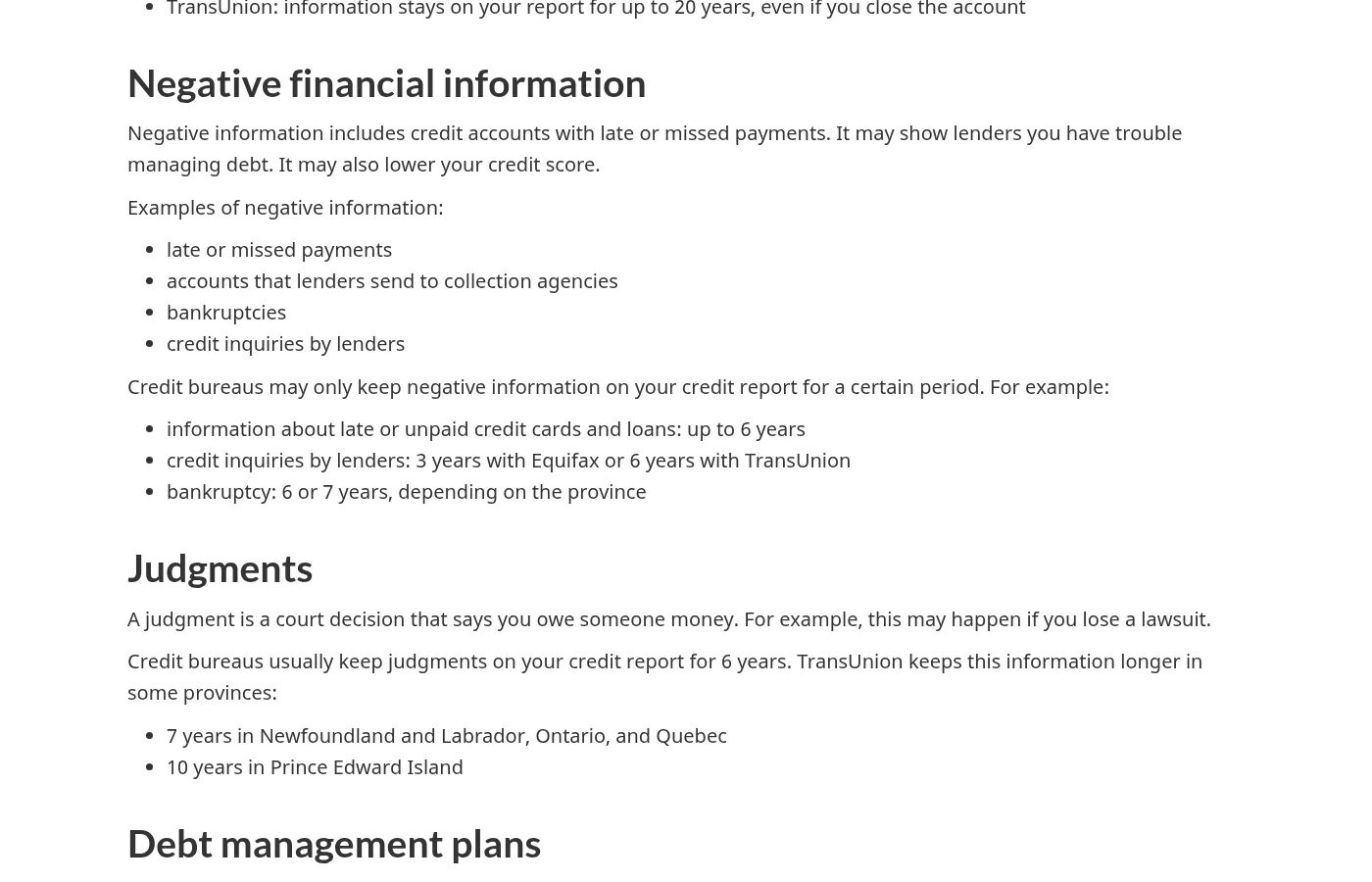
canada.ca, November 1, 2026. Look at the middle list: late payments up to 6 years, inquiries 3 years at Equifax and 6 at TransUnion, bankruptcy 6 or 7 years depending on the province.
Good news stays longer. Accounts you paid on time stay on your report for years after you close them, which is one more reason to keep your oldest card.
And no company can scrub real history off your file for a fee. FCAC says it's "impossible to change or erase information that's part of your credit history, unless information is inaccurate." If something is wrong, disputing it is free. How to Check Your Credit Score for Free shows how.
Three myths
"Carry a balance to build credit." No. What gets reported is whether you paid on time and how much of your limit you used. No interest charge shows up on your report. Cards charge about 20% interest, so carrying $1,000 for a year costs you around $200 and builds exactly the same history as paying in full. Pay the full statement balance every month.
"Checking your score lowers it." No. FCAC: "Checking your own credit report or score doesn't affect your credit score." It's a soft inquiry.
"Close the cards you don't use." Usually a mistake. FCAC warns that closing an old account means you "lose older credit history" and "reduce your available credit," so the same spending takes up a bigger share of your limit. A no-fee card costs nothing to keep open. Use it for something small every few months so the bank doesn't close it for you.
What to do next
If you're starting from zero, these are the posts I'd read in order:
- How to Build Credit With a Credit Card: the month-by-month plan for your first card.
- How to Check Your Credit Score for Free: where to see both of your scores without paying anyone.
- Building Credit as a Newcomer: if your credit history is in another country.
- What Is a Secured Credit Card?: if the banks keep saying no.
Before you apply: confirm the details on the bureau's or bank's own page. Everything in this post is dated November 1, 2026, the day it was written, and the rules and offers can change. General information, not financial advice, and no affiliate links. Full details in our Terms of Use.