How to Build Credit With a Credit Card
Pay only the minimum on a $2,000 card balance and you hand the bank $793 in interest over almost four years. Pay in full every month and you build the same credit for $0. Here is the plan, month by month.
A first credit card is the cheapest credit-building tool in Canada, as long as you use it the boring way. This post covers what to set up on day one, when you'll get a score, when to ask for a higher limit, and when to add a second card. If you're not sure how the score itself works, read How Credit Scores Work first.
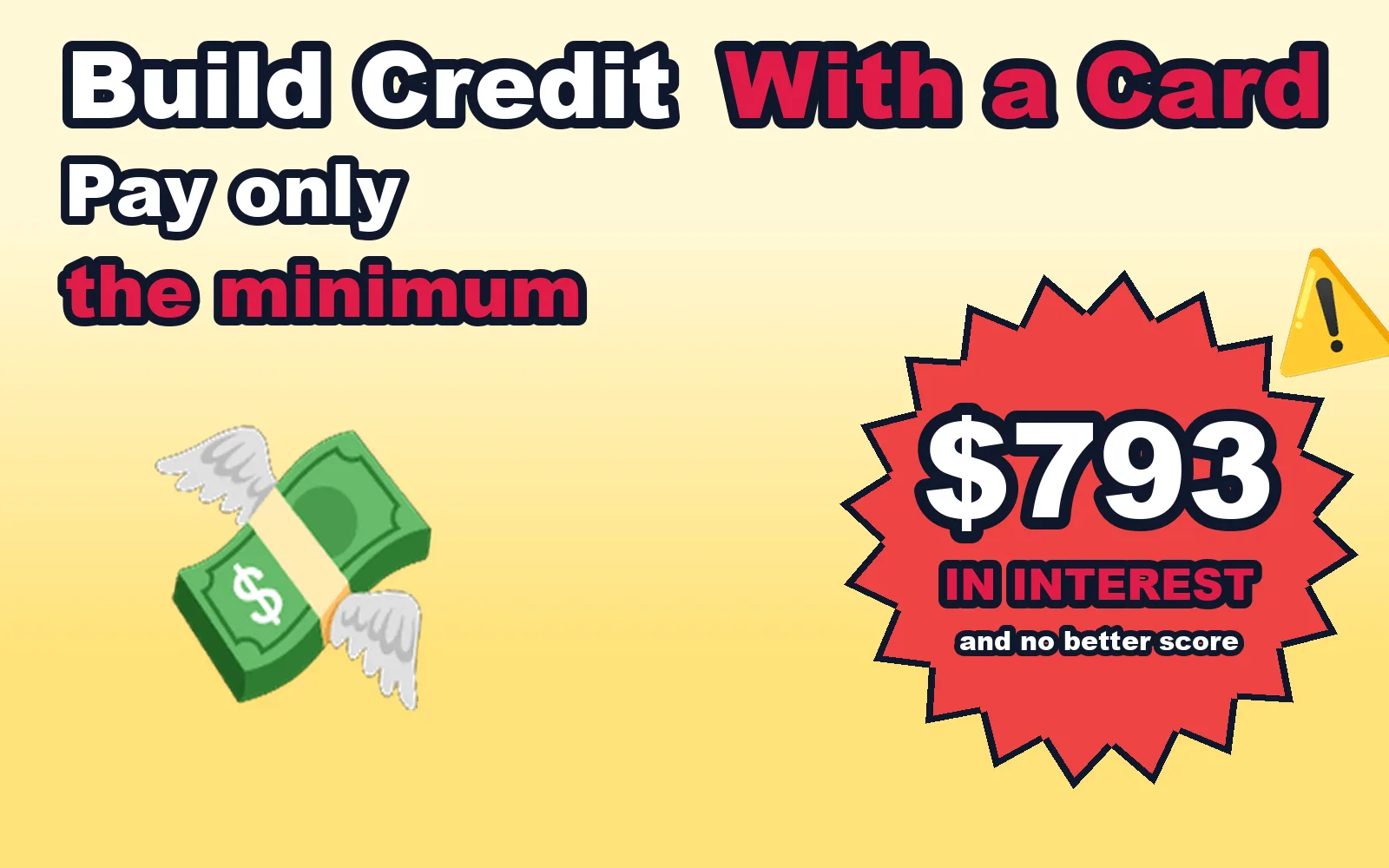
The whole post in one picture. The receipts are below.
Before you start: one card is enough
You need one no-fee card in your own name. Which one depends on where you're starting:
- Student: The Best Credit Card for Students
- New to Canada: The Best Credit Card for Newcomers
- Turned down everywhere: What Is a Secured Credit Card?
Being an extra cardholder on a parent's or partner's card doesn't count. FCAC says purchases made as an additional cardholder "won't help you build your credit history," and Scotiabank says the card "isn't reported on their credit report." The history belongs to the main cardholder. You need your own account.
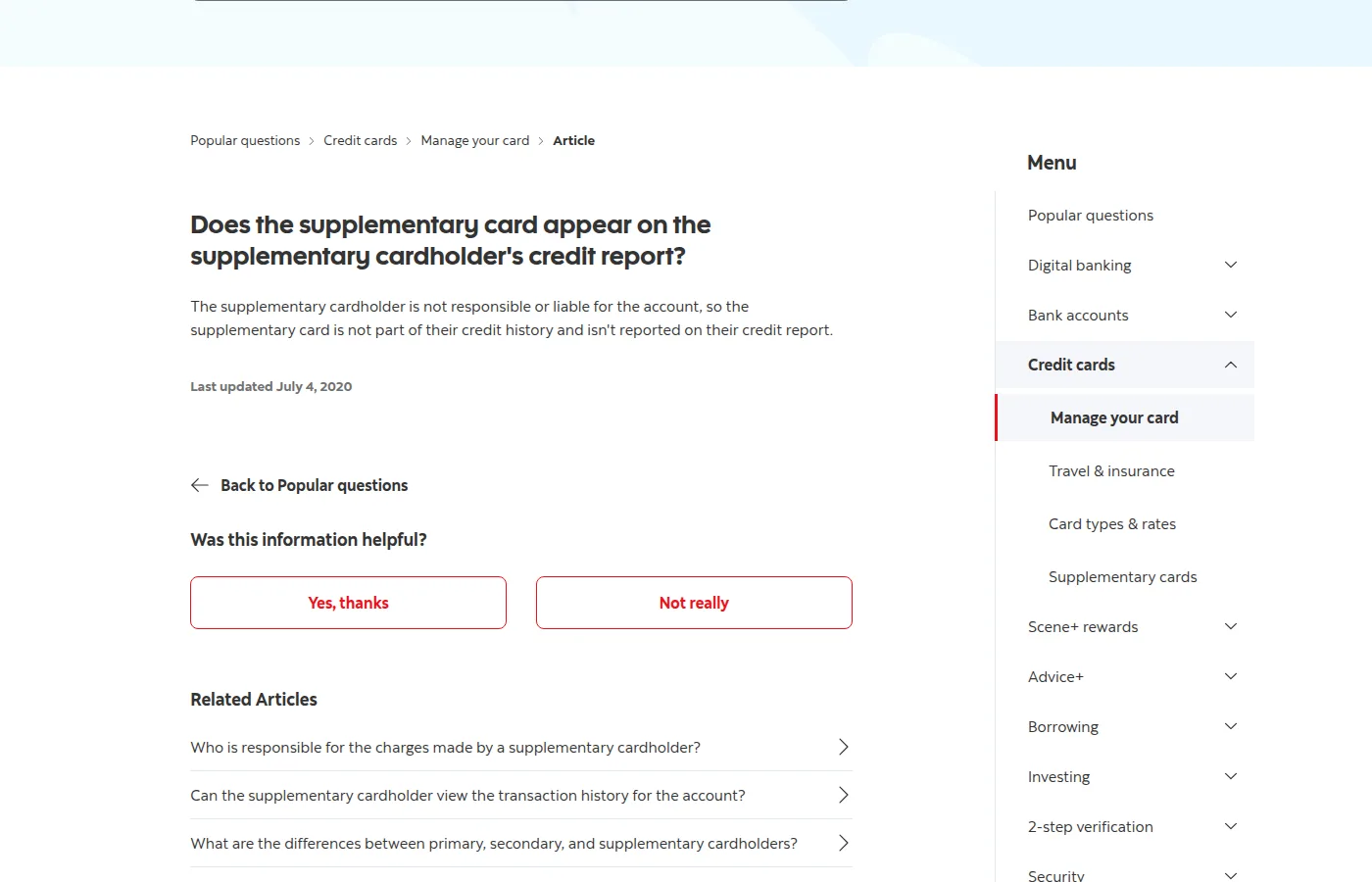
help.scotiabank.com, November 1, 2026. One sentence under the question, and it's a no.
Day one: set up an automatic payment for the full balance
Do this before you buy anything. TD, RBC and Scotiabank all let you choose between paying the minimum and paying the full statement balance automatically from your chequing account. Pick the full balance.
Here's why it matters. By law, a bank can't charge interest on purchases if you pay the full balance by the due date, and the due date has to be at least 21 days after your statement. That's a free loan every month, as long as you pay it all.
The minimum payment is the trap. It's usually $10 or 3% of the balance, whichever is higher (5% in Quebec since August 2025). FCAC worked out what that costs on a $2,000 balance at 18%:
| You pay | It takes | Interest |
|---|---|---|
| The minimum, $60 a month | 3 years, 11 months | $793 |
| $160 a month | 1 year, 2 months | $231 |
| The full balance | 1 month | $0 |
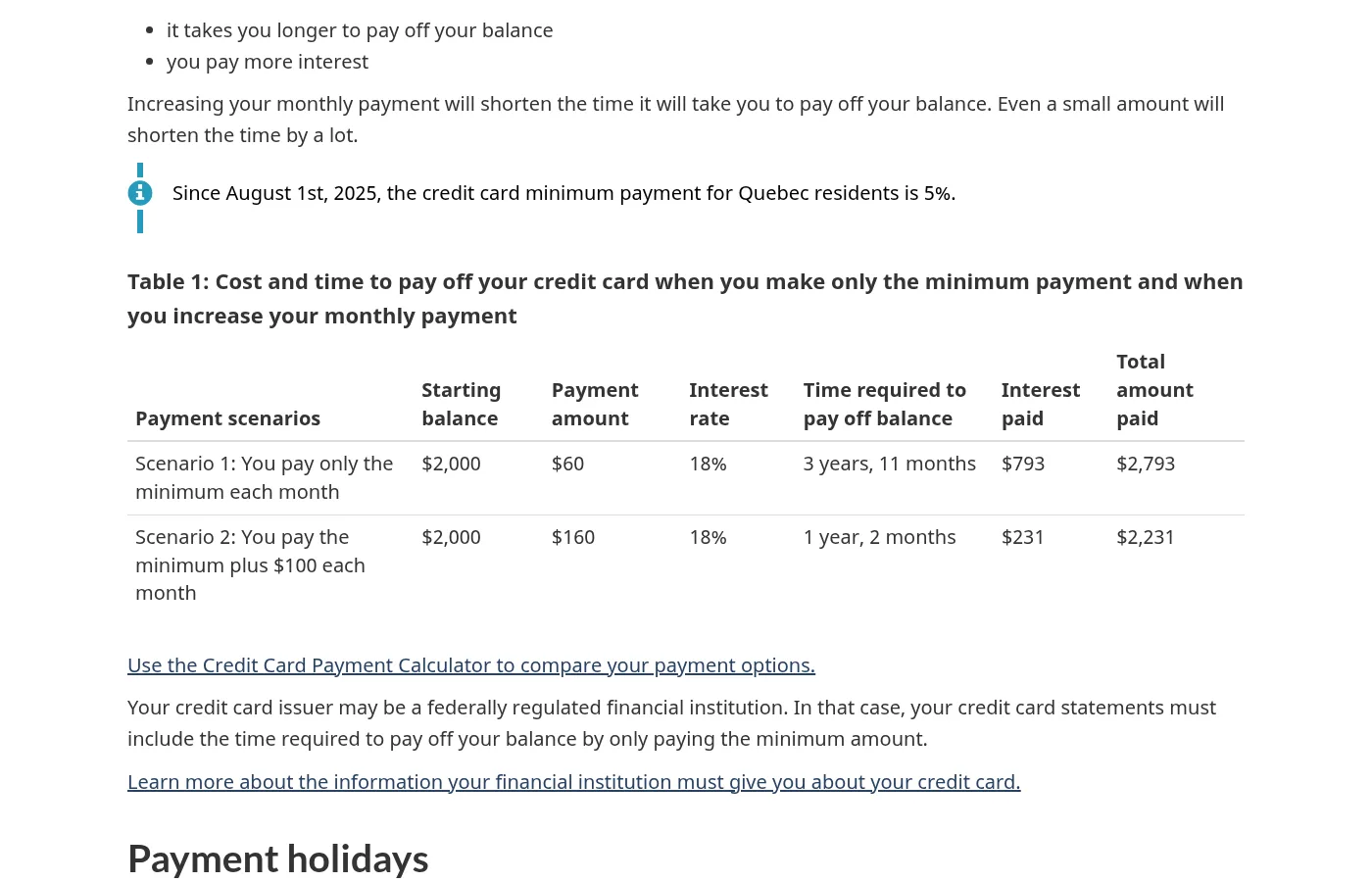
canada.ca, November 1, 2026. Table 1, top row: $793 in interest on a $2,000 balance. The full-balance row is my addition, and it's the one to aim for.
Missing a payment costs more than interest. A late payment stays on your report for up to 6 years, even after you pay it, and banks can raise your rate. TD's Cash Back Visa Infinite agreement, for example, raises the purchase rate by five percentage points if you miss the minimum twice in 12 months, and keeps it there until you've paid on time for 12 statements in a row. Autopay makes all of this impossible to forget.
Months 1 to 3: use it a little
Put one or two regular bills on the card, like your phone plan or a streaming subscription, plus a few groceries. Then leave it alone.
Keep the balance under 30% of your limit. FCAC's rule of thumb is "less than 30% of your total credit limit." On a $1,000 limit, that means under $300. This counts even when you pay in full, because the card company reports your balance to the bureaus once a month, whatever it happens to be that day.
If you had a big month, Equifax's tip works: "making multiple payments during your billing cycle can reduce the balance that gets reported." Pay part of it early, before the statement comes out, and a smaller number gets reported.
Months 4 to 6: you get a score
Your file needs a few months of history before there's anything to score. Equifax says most people become "scoreable" after about three months of reported credit, or four to five months in total once the reporting catches up.
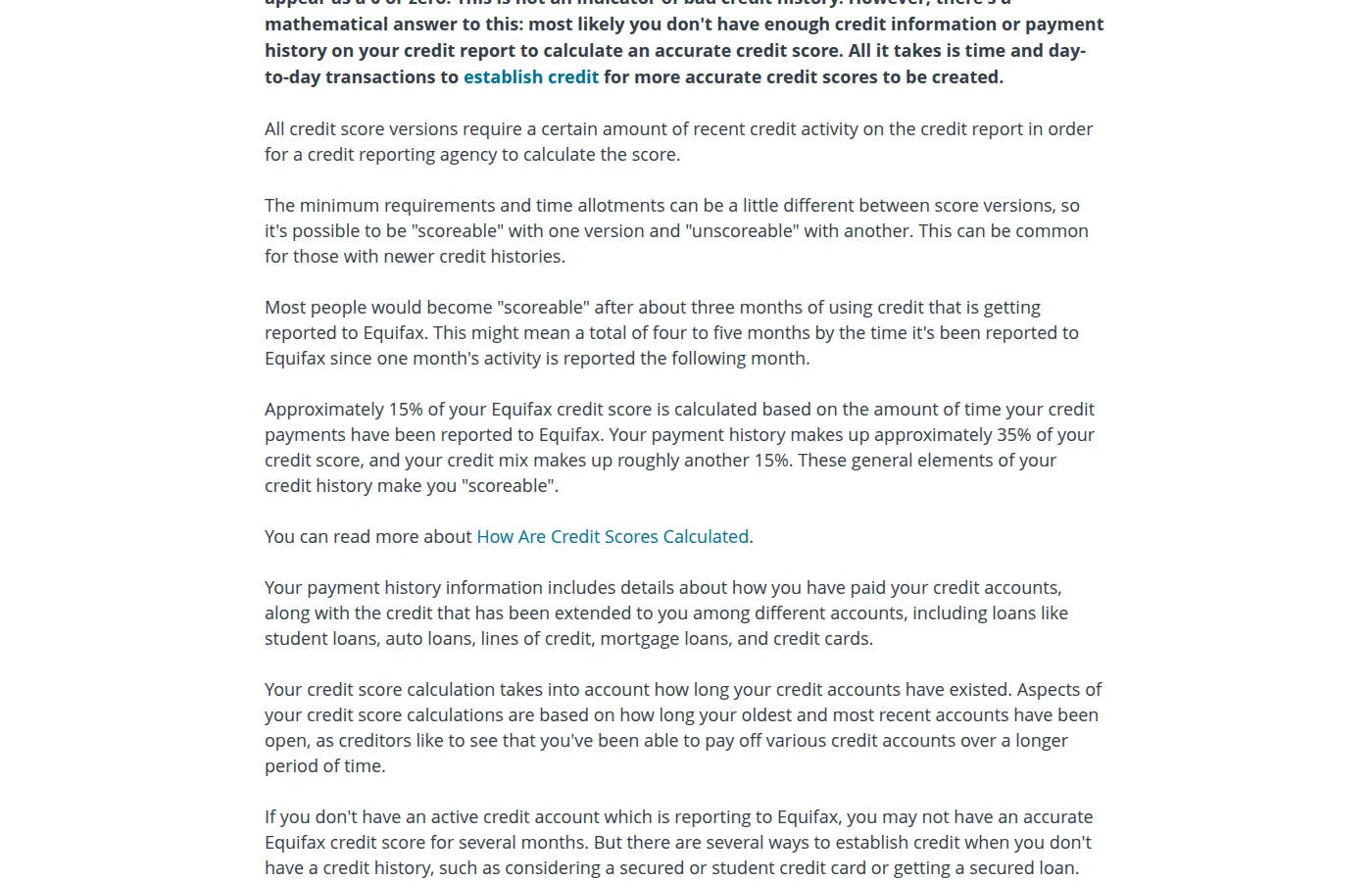
equifax.ca, November 1, 2026. The fourth paragraph: about three months of credit use, four to five months once it has been reported.
Once you're past that, check your score for free. How to Check Your Credit Score for Free lists where, including apps that show you both bureaus. Don't panic if your first number is modest. A short history is normal at this stage, and it's the part only time can fix.
Months 6 to 12: ask for a higher limit, once
A higher limit with the same spending means you're using a smaller share of it, and that's 30% of your score. Two things to know first:
- The bank needs your yes. Under the Bank Act, a bank can't raise your limit without your "express consent," and simply using the card doesn't count as consent. If an increase is offered, you can say no.
- Asking can cost you a hard inquiry. RBC says a requested increase "may involve a 'hard inquiry'," and Scotiabank says online requests mean giving it "permission … to perform a hard credit check." An increase the bank offers you on its own is a soft check.
So I'd wait for the bank to offer, or ask once after six months of clean payments. Scotiabank's own advice is to wait "four to six months to a year" between requests. And a higher limit is not more money to spend. It's room.
After a year: add a second card, and keep the first
After 12 months of on-time payments, you're a normal applicant. Now you can pick a card for what it pays you, not for whether it'll approve you.
Keep your first card open. Equifax suggests "keeping at least one or two credit cards open (even with a zero balance)," because closing old accounts lowers the average age of your history, which is about 15% of your score. A no-fee starter card costs nothing to keep. Put a small bill on it every few months so it stays active.
If your first card has a fee you no longer want, ask the bank to move you to its no-fee version instead of closing it. Ask whether you'll keep the same account, because that's what keeps the history.
Space out your applications. Each one is a hard inquiry, and Equifax keeps those for 3 years, TransUnion for 6. Once your file has a couple of years in it, Credit Card Churning 101 is where this gets fun.
The one-page version
- Get one no-fee card in your own name.
- Day one: set up autopay for the full statement balance.
- Use it for one or two bills and keep the balance under 30% of the limit.
- Around month 4 to 6, check your score for free.
- Around month 6 to 12, take a limit increase if the bank offers one.
- After a year, add a second card. Never close the first one.
And the rule under all of it: pay the full statement balance every month. These cards charge about 20% interest, and none of that interest builds a single point of credit.
Before you apply: confirm the details on the bank's own page. Everything in this post is dated November 1, 2026, the day it was written, and banks change their terms whenever they like. General information, not financial advice, and no affiliate links. Full details in our Terms of Use.