What Is a Secured Credit Card?
The secured card I'd pick costs $0 a year. You give the bank a deposit, it gives you a real credit card, and you start a credit history from zero. Here is how.
A secured card is the least exciting card in Canada and one of the most useful. This post covers what "secured" means, who should get one (and who shouldn't), what it really costs, how to graduate out of it, and which one I'd open today after checking every issuer's own page.
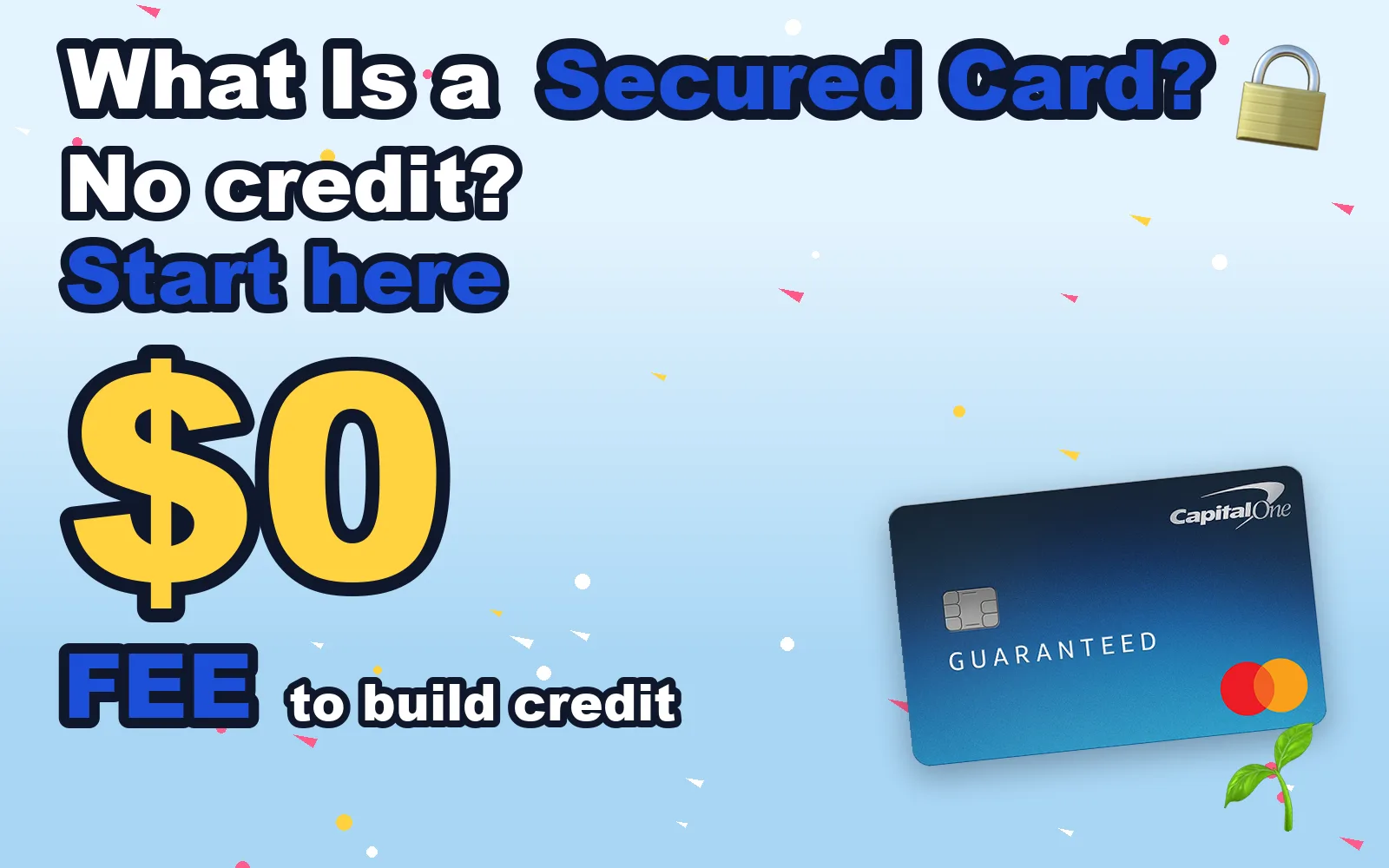
The whole post in one picture. The receipts are below.
What "secured" means
A normal credit card is the bank lending you money on trust. A secured card is the bank lending you money on your own cash. You hand over a deposit, and that deposit becomes your credit limit. Put down $500, get a $500 limit. If you stop paying, the bank keeps the deposit. That is the whole trick, and it is why almost anyone gets approved.
Here is the part people miss: it is a real credit card, not a prepaid card. You spend first and pay the bill later, the same as any other card. That is exactly why it builds credit. A prepaid card spends money you already loaded, so there is no bill, no payment history, and nothing for the credit bureaus to see.
Who should get one
- You have no credit history. Students, people who have always paid cash, anyone whose credit file is empty. No file means no score, and no score means most banks say no.
- You just moved to Canada. Your credit history from home doesn't follow you. You start at zero here.
- You are rebuilding. Missed payments, an account sent to collections, a consumer proposal or a bankruptcy that has been discharged. Unsecured cards will say no for a while. A secured card is how you show the bureaus a fresh run of on-time payments. (One catch: Home Trust won't take you while you are currently in bankruptcy.)
Who shouldn't
If a bank will give you a no-fee unsecured card, take that instead. Same credit-building, no deposit tied up. Try first, with a pre-approval tool that doesn't do a hard credit check. Capital One's Quick Check and Neo's pre-approval both work this way. Some starter cards ask for very little: National Bank's MC1 Mastercard has no annual fee and no minimum income, and Tangerine's Money-Back card asks for $12,000 a year in income. Either of those beats parking a deposit.
And if you know you will carry a balance, stop here. A secured card doesn't fix spending more than you earn. It just charges you up to 29.9% for it.
How it builds credit
Every month the card company tells the credit bureaus how you used the card. Canada has two: Equifax and TransUnion. Your score is built from what they hear. Two things matter most, and you control both:
- Pay on time, every time. Payment history is the biggest piece of your score. One payment more than 30 days late can undo months of good work. Set up an automatic payment for the full statement balance on day one.
- Keep the balance low. The bureaus look at how much of your limit you are using, called utilization. Try to keep your statement balance under 30% of your limit. On a $500 limit that means under $150 when the statement closes. Put your phone bill and a few groceries on it, pay it in full, and that is enough.
Check which bureaus your card reports to. Neo says plainly that it reports to both. Capital One says it reports "to the credit reporting agencies each month". Home Trust says "to the credit bureau". Lenders may check either one, so both is better.
What it actually costs
The annual fee is the obvious cost. There are three less obvious ones.
1. Your deposit is stuck. You can't spend it, and on Capital One's card any interest it earns goes to Capital One, not you. Home Trust's agreement doesn't promise you any interest either. So the real cost is what that money would earn elsewhere. At 3% in a savings account, a $500 deposit costs about $15 a year. Not much, but it's real money, and you only get it back when you close the card and pay it off.
2. The interest rate is brutal. These cards charge 19.99% to 29.9%. Home Trust's own agreement shows what that looks like: carry $500 for one month at 19.99% and you pay $8.22 in interest. Carry it for a year and you are around $100. That is more than the deposit cost, the fee and everything else combined. Pay the full statement balance every month. Not the minimum. The full balance.
3. Small fees. Home Trust charges $12 if you go 12 months without using the card, $29 if you go over your limit, and 2% on anything in a foreign currency. Capital One only lists its other fees in the disclosure you get at approval. Read it.
The secured cards in Canada, side by side
I checked every card below on the issuer's own website on October 17, 2026.
| Deposit | What it costs you | The catch | |
|---|---|---|---|
| Capital One Guaranteed Secured | Set at approval, not published | $0 fee, 29.9% interest | Capital One keeps any interest on your deposit |
| Home Trust Secured Visa | $500 to $10,000 | $0 fee at 19.99%, or $59 at 14.90% | Not in Quebec, not while bankrupt |
| Neo Mastercard (secured) | From $50 | $9.99 a month membership | The only one with cash back |
| TD (secured version of a regular card) | Not published | Same as the regular card | Terms aren't online |
My pick: the Capital One Guaranteed Secured Mastercard. It costs $0 a year and approval is guaranteed if you meet four conditions: you are the age of majority, your credit isn't frozen or legally blocked, you don't already have a Capital One card or application, and you haven't left Capital One on bad terms in the last year. It works in Quebec too (at 21.9%). It even comes with purchase protection and an extended warranty, which is more than the Home Trust card offers.
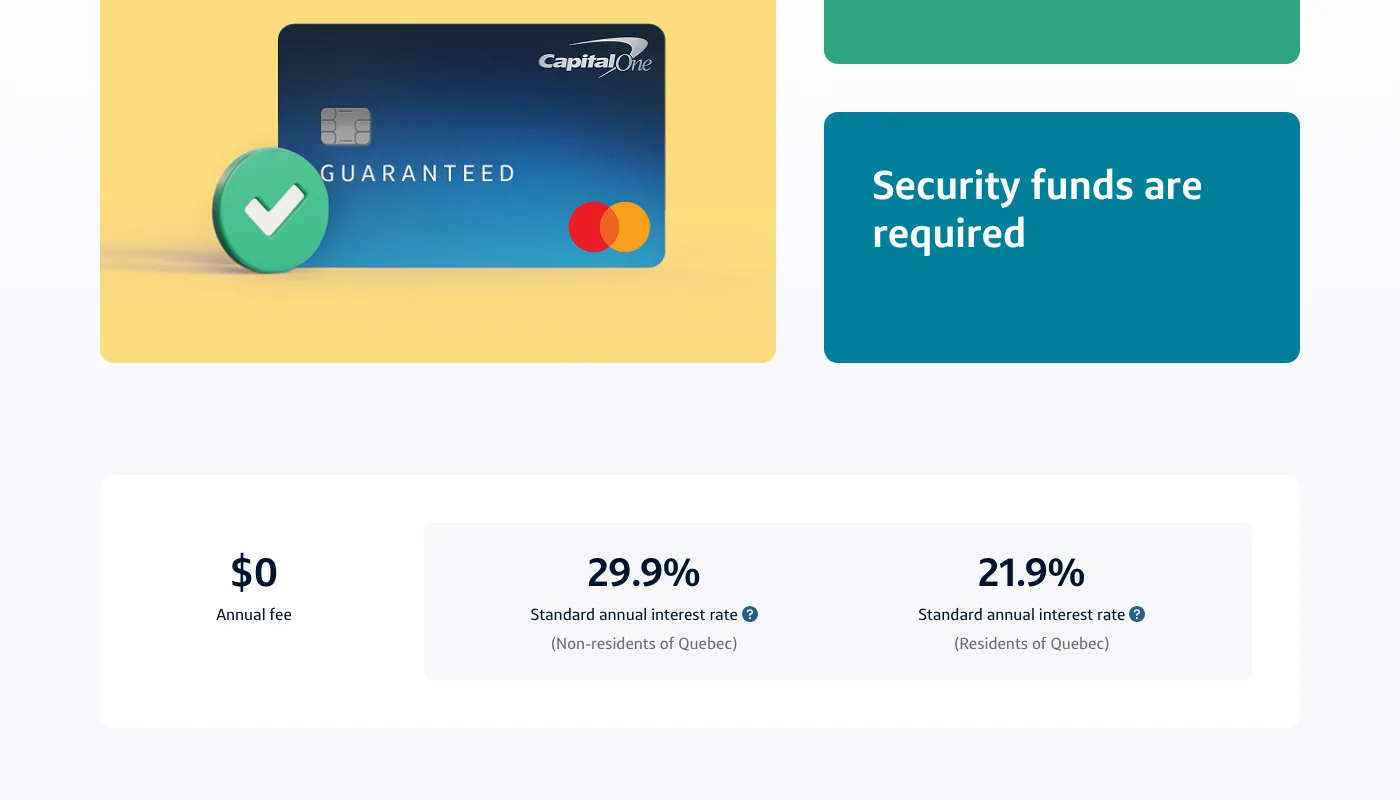
capitalone.ca, October 17, 2026. "Security funds are required", but look for the amount: it isn't there. Capital One tells you how much after it approves you.
Three honest downsides. First, Capital One doesn't publish the deposit. You find out after approval. Second, the rate is 29.9%, the highest here, which only matters if you carry a balance, and you won't. Third, adding money only raises your limit up to $2,500, and getting your deposit back after closing can take up to 150 days. One tip: run Quick Check on the Capital One Guaranteed Mastercard too. It's the same card, but Capital One says security funds "may be required", so some people get it with no deposit at all.
Runner-up: the Home Trust Secured Visa, if you live outside Quebec and can spare $500. You pick your limit, anywhere from $500 to $10,000, and the no-fee version charges 19.99%, well under Capital One's 29.9%. Your deposit is covered by CDIC while Home Trust holds it. Skip the $59 low-rate version: a lower rate only helps people who carry a balance.
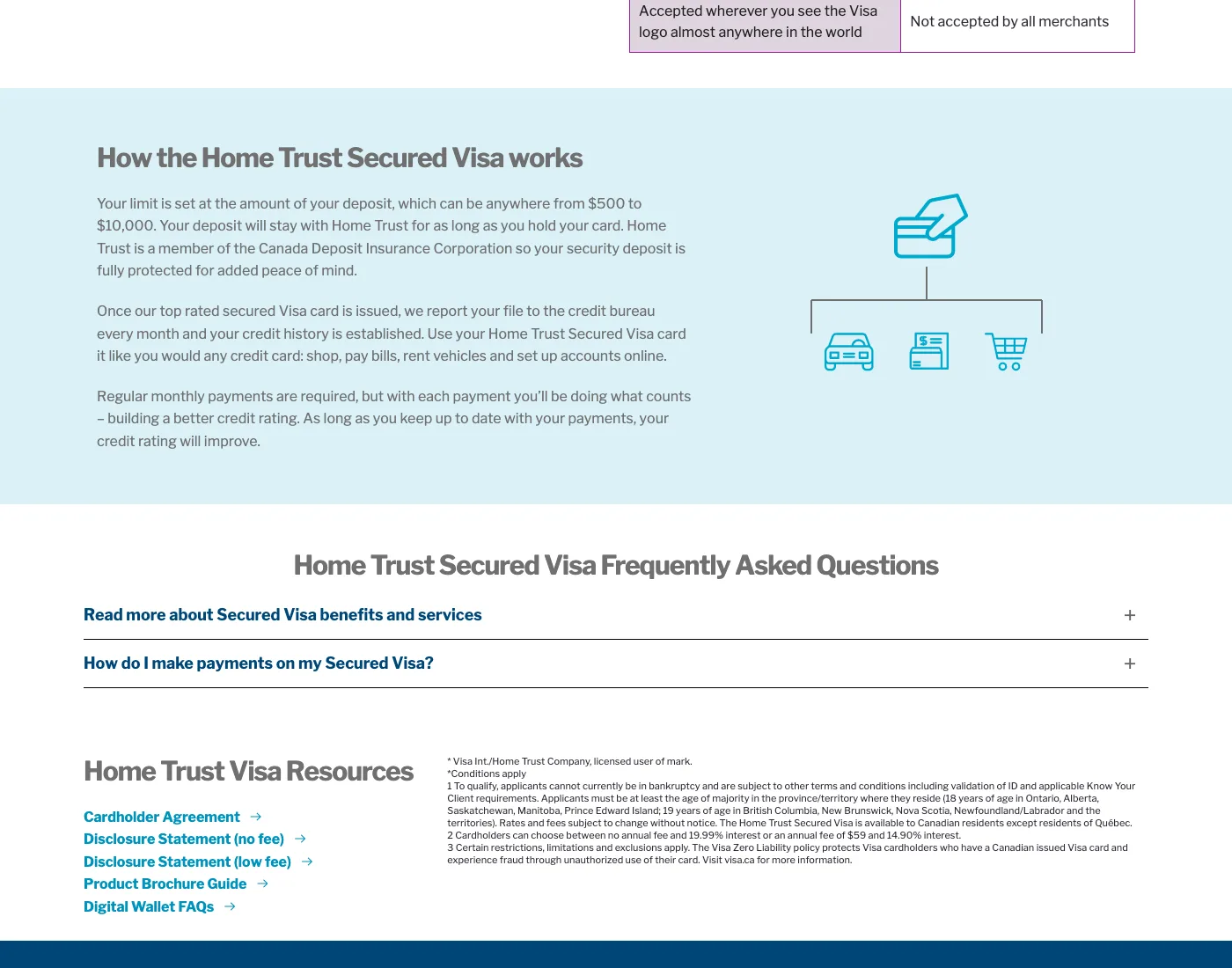
hometrust.ca, October 17, 2026. The deposit range is in the first paragraph. The fine print on the right says you can't apply while you are currently in bankruptcy, and the card isn't available in Quebec.
The one with rewards: Neo Mastercard, secured. Neo folded its secured card into the regular Neo Mastercard. If your credit is thin, it offers you a "secured credit limit" instead, starting from a $50 deposit. You get the same cash back as the regular card, it reports to both Equifax and TransUnion, and Neo checks monthly whether you've earned a higher limit without adding money. That's the best upgrade path here.
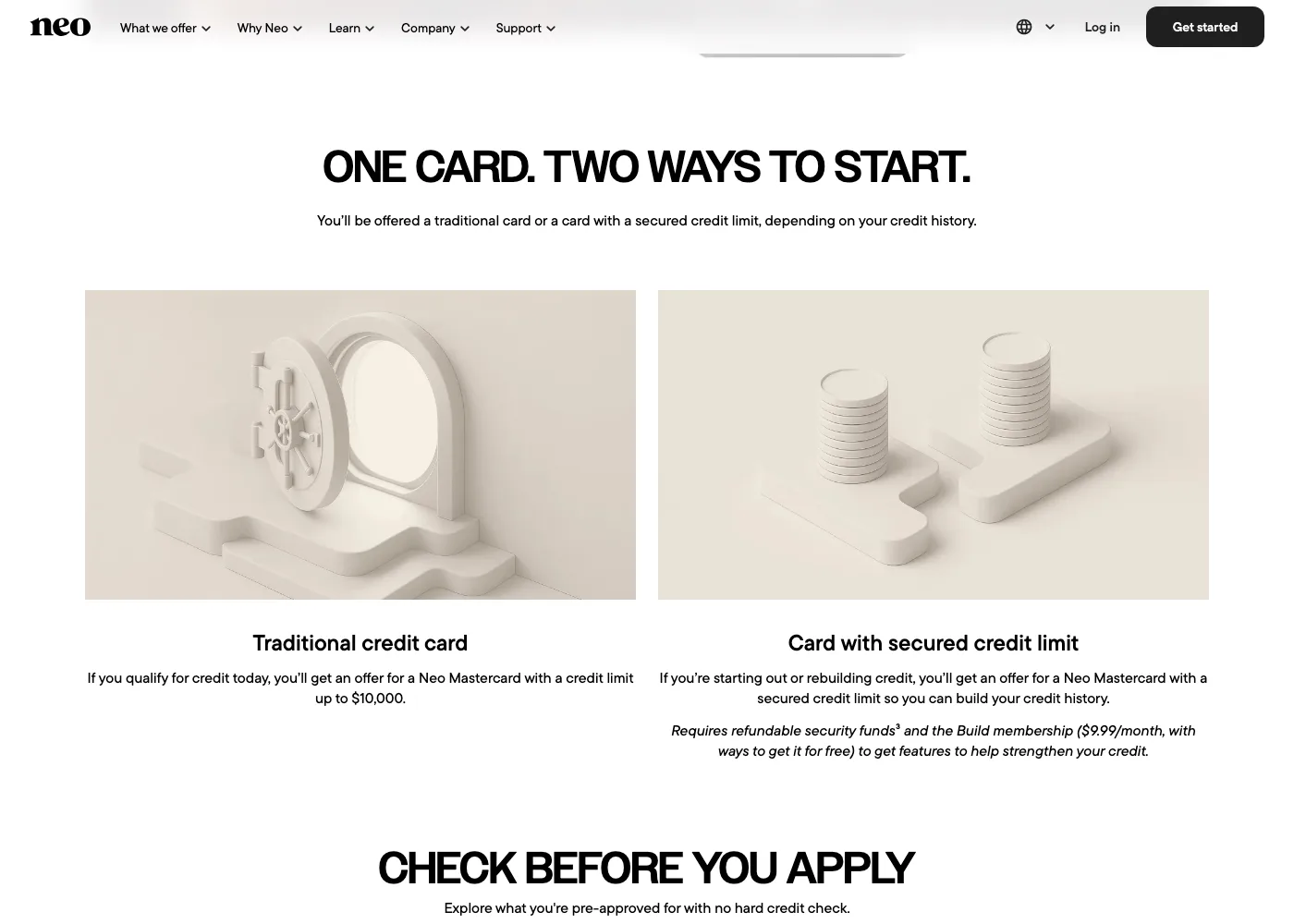
neofinancial.com, October 17, 2026. Read the italic line on the right: the secured version "requires" the Build membership at $9.99 a month. The "ways to get it for free" only apply to Neo's World Elite cards.
The catch is that membership. $9.99 a month is about $120 a year, so the cash back has to beat $120 before you are ahead of the $0 cards. Neo also says the secured limit needs a paid membership, and cancelling the membership means closing the card. The card says "no annual fee". The membership is an annual fee in everything but name.
If you bank with TD. TD doesn't sell a separate secured card. It lets you secure one of six regular cards, from the TD Cash Back Visa to the TD First Class Travel Visa Infinite, with "funds you deposit with us", and the limit depends on your deposit. You'd earn real rewards from day one. But td.com doesn't publish the deposit amounts, so you'd have to ask in a branch.
Not a card at all: KOHO Credit Building. KOHO sells a tool that reports a small, interest-free line of credit to Equifax and TransUnion. No deposit, no hard credit check. But it isn't a credit card, so you can't buy anything with it. It's a supplement, not a replacement.
What I left out. RBC, Scotiabank, CIBC, National Bank, Desjardins and Tangerine have no secured card on their own sites. Plastk's website is an empty page, and Refresh Financial's site now redirects to Borrowell. BMO's newcomer pages wouldn't load for me, so I can't vouch for its secured option.
How to graduate
The point of a secured card is to stop needing one. Here is how I'd do it:
- Use it lightly and pay it in full for 6 to 12 months. That's my rule of thumb, not a bank's. Rebuilding after serious trouble can take longer.
- Check your score for free. Neo shows your TransUnion score in the app with a membership, Capital One has its free Credit Keeper tool, and Equifax lets you check yours on its own site.
- Run a pre-approval check for a no-fee unsecured card (no hard credit check). Capital One's Quick Check shows which of its cards you'd be pre-approved to switch to. Neo checks every month whether you qualify for a higher limit without adding money, and says this can happen in as little as 3 months. Home Trust doesn't describe any upgrade path, so you'd apply somewhere else.
- Open the new card first, then close the secured one. Closing it is how you get the deposit back. Home Trust returns it within about four weeks; Capital One can take up to 150 days. Wait until the new card is in your hand, because closing an account lowers your total limit, which pushes your utilization up.
Once you have a normal card and a year of clean history, the fun part opens up. Credit Card Churning 101 is where I'd go next.
Before you apply: confirm the live offer on the bank's own page. Everything in this post is dated October 17, 2026, the day it was written, and banks change their offers whenever they like. General information, not financial advice, and no affiliate links. Full details in our Terms of Use.