Best Credit Card for Spending Abroad
Spend $20,000 abroad on a typical Canadian credit card and the bank keeps about $300 more than it gives back. On a card with no foreign fee you come home $200 ahead. That $500 gap is this post: which cards do it, what I counted, and whether it is worth opening a new card just for travel.
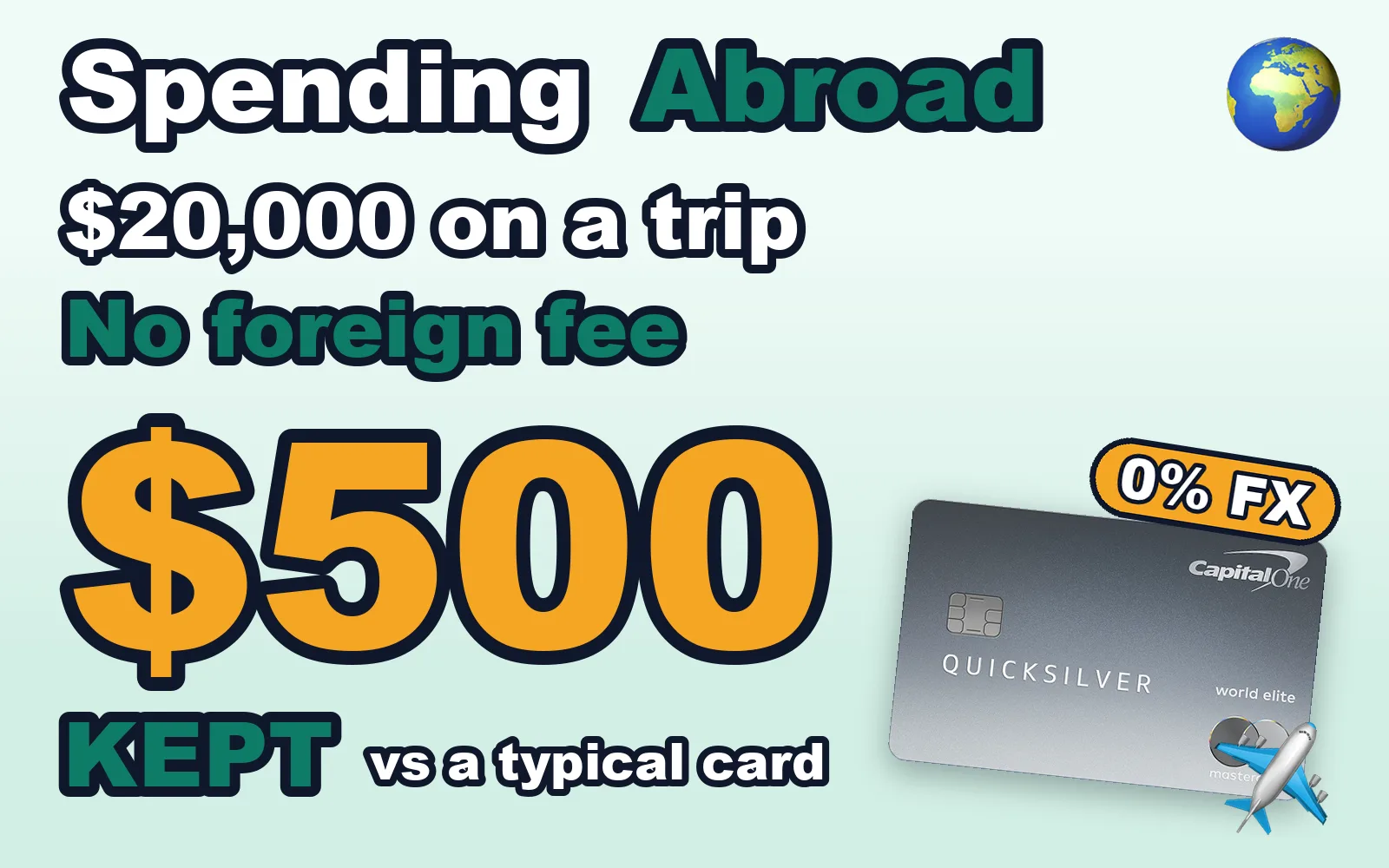
The whole post in one picture. The numbers are real and the receipts are below.
The 2.5% that never shows on the receipt
When you pay in euros, yen or US dollars, Visa or Mastercard converts the price to Canadian dollars at its own rate. Then almost every Canadian card adds 2.5% on top. It is called a foreign transaction fee, and it shows up on your statement folded into the converted amount, not as its own line.
Most cards pay about 1% back on that purchase. So every foreign dollar costs you 1.5% net. On a $20,000 year of travel that is $300 gone, and on $30,000 of US-dollar spending it is $450. A handful of cards charge no foreign fee at all, which turns the same spending into a small profit.
How I counted
I ran every card in our library of 71 cards, using each bank's own page as checked on October 17, 2026.
- Foreign purchases earn the card's base rate. Most bonus categories are built around Canadian merchants. Scotiabank's Gold Amex terms, for one, give purchases in a foreign currency the base 1 point per dollar. A dinner in Lisbon earns the everyday rate.
- Points at their simplest value, the one anyone gets without transfer tricks (about 1 cent a point for Scene+).
- The annual fee is shown separately. If you already hold the card, the fee is spent either way.
- Welcome offers are left out. They are one-time, and they would swamp the comparison.
- US-dollar specials only count on US dollars. One card in the library, the Rogers Red World Elite, pays more on US-dollar purchases. I counted that in the US-dollar scenario and nowhere else.
- Pay your balance in full. At 20% interest, nothing in this post survives carrying a balance.
$20,000 in euros, yen or pesos
| Card | Back on $20,000 | Annual fee | Why |
|---|---|---|---|
| Wealthsimple Credit Card | +$400 | $240, waivable | 2% on everything, no foreign fee |
| Capital One Quicksilver World Elite | +$200 | $0 | 1% abroad, no foreign fee |
| Scotiabank Passport Visa Infinite | +$200 | $150 | 1 Scene+ point per $1, no foreign fee |
| Scotiabank Gold Amex | +$200 | $120 | Same, but it is an Amex |
| Rogers Red World Elite | −$100 | $0 | 2% back, 2.5% fee |
| Amex SimplyCash Preferred | −$100 | $120 | 2% back, 2.5% fee |
| Brim World Elite | −$100 | $89 | 1% back, 1.5% fee |
| A typical card (1% back, 2.5% fee) | −$300 | varies | Most of the library |
The four winners are the only four cards in the library with no foreign fee. Everything else loses money abroad. Even the 2% cards only get you to minus $100, because 2% does not cover 2.5%. The Capital One Quicksilver World Mastercard earns exactly what its World Elite sibling does here, also for $0.
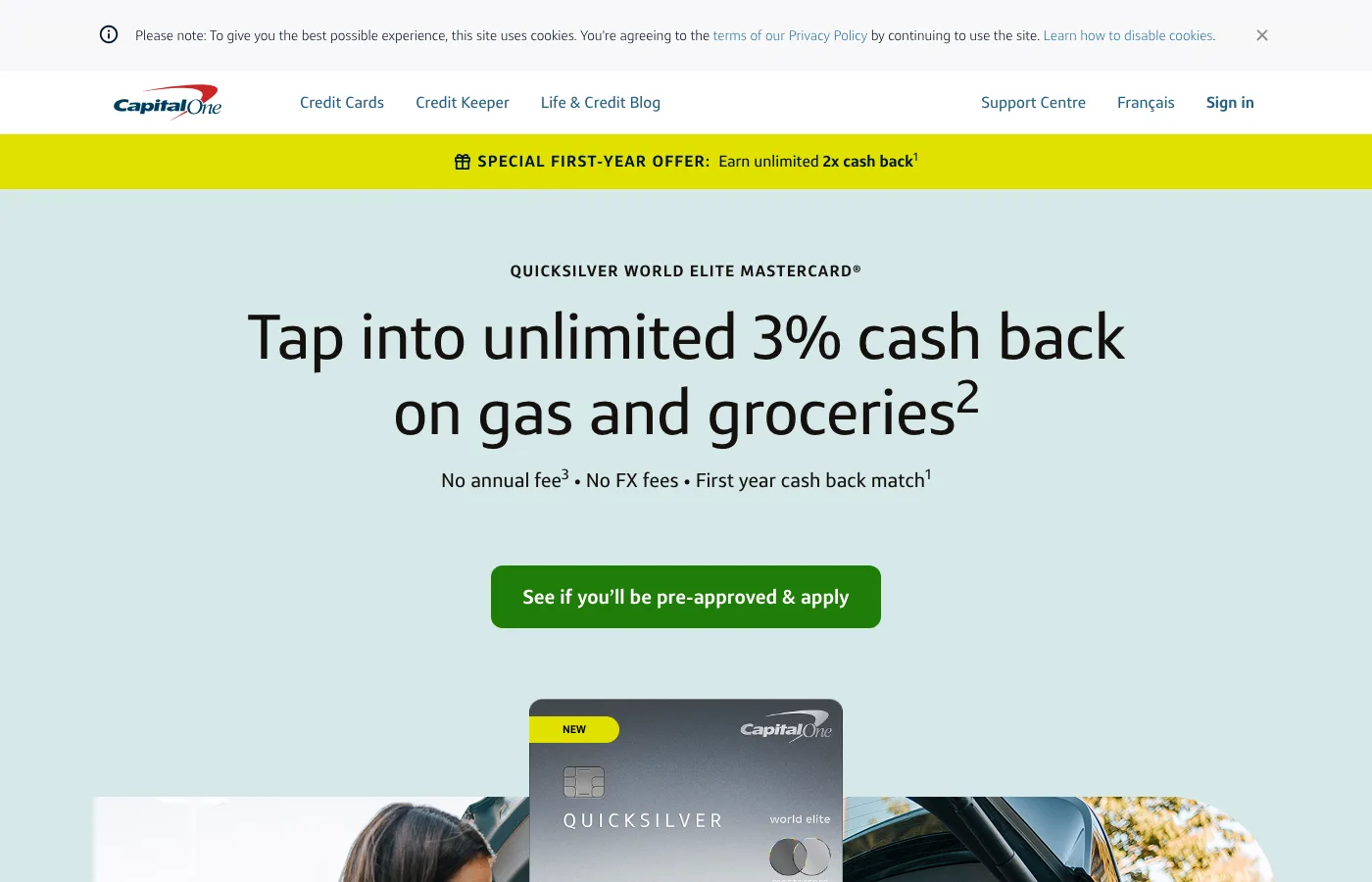
capitalone.ca, October 17, 2026. "No FX fees" sits right under the headline. The fine print says it covers purchases made outside Canada, so a foreign-currency purchase you make online from home is not confirmed.
$30,000 in US dollars
| Card | Back on $30,000 | Annual fee |
|---|---|---|
| Wealthsimple Credit Card | +$600 | $240, waivable |
| Capital One Quicksilver World Elite | +$300 | $0 |
| Scotiabank Passport Visa Infinite | +$300 | $150 |
| Scotiabank Gold Amex | +$300 | $120 |
| Rogers Red World Elite | +$150 | $0 |
| A typical card (1% back, 2.5% fee) | −$450 | varies |
This is where the Rogers special matters. The Rogers Red World Elite pays 3% on US-dollar purchases, for Rogers customers and everyone else, then charges its 2.5% fee. Net: +0.5%, or $150. Without the special it would be minus $150, like the other 2% cards. It is a real perk, and it still pays half of what the four no-fee cards pay.
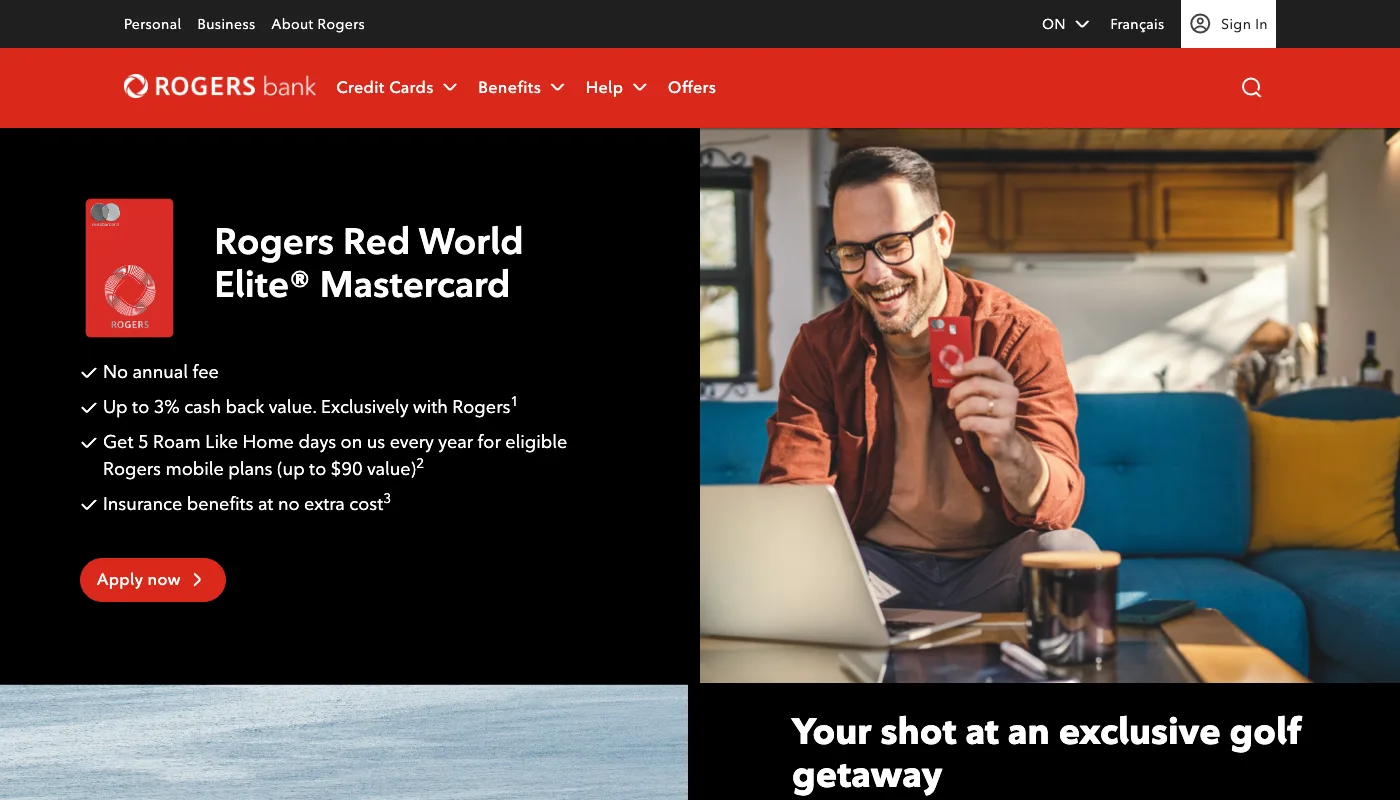
rogersbank.com, October 17, 2026. The "up to 3%" is the US-dollar rate, and the footnote says it stops after $61,000 of total spending a year. The 2.5% foreign fee is not on this page; it is in Rogers Bank's card fees.
Wealthsimple wins, if the fee goes away
Wealthsimple pays 2% on everything with no foreign fee, which is why it tops both tables. The catch is $20 a month ($240 a year). It is waived if you hold $100,000 with Wealthsimple or send it $4,000 a month in direct deposit. You also need a Wealthsimple chequing account and $80,000 of personal income, and Wealthsimple says the card is "only available in limited quantities".
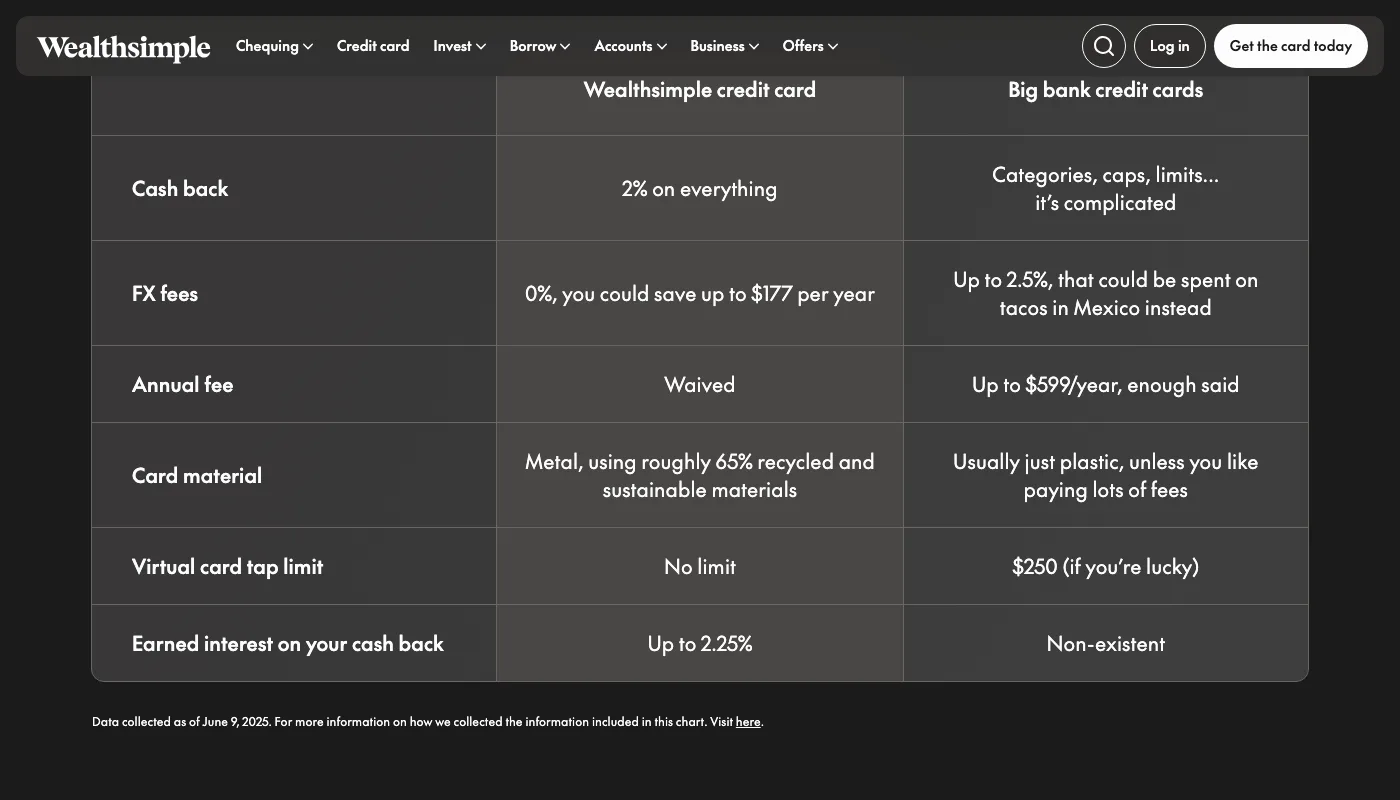
wealthsimple.com, October 17, 2026. The table says "Annual fee: Waived". That is the case only if you meet the conditions above. Otherwise it is $240 a year.
If you pay the fee, Wealthsimple beats the free Quicksilver only above $24,000 a year of foreign spending, the point where its extra 1% covers $240. Below that, the Quicksilver keeps more.
Should you open a new card just for travel?
- You already hold one of the four no-fee cards: no. Use it abroad and stop there.
- You hold none of them: yes, the Quicksilver is the easy answer. It costs nothing to keep, and on $20,000 abroad it is $500 better than a typical card. It needs $80,000 personal income (the Quicksilver World needs $50,000). Applying means a credit check.
- You want travel insurance with it: the Scotiabank Passport. The Quicksilver has no travel medical and no trip cancellation. The Passport covers emergency medical up to $2 million for the first 25 days of a trip (under 65) and comes with 6 airport lounge visits a year. The $150 fee is rebated if you hold a Scotiabank Ultimate Package.
- You hold a Rogers Red World Elite: keep it for US dollars only if you want one card. A Quicksilver beside it earns twice as much on the same US-dollar spending.
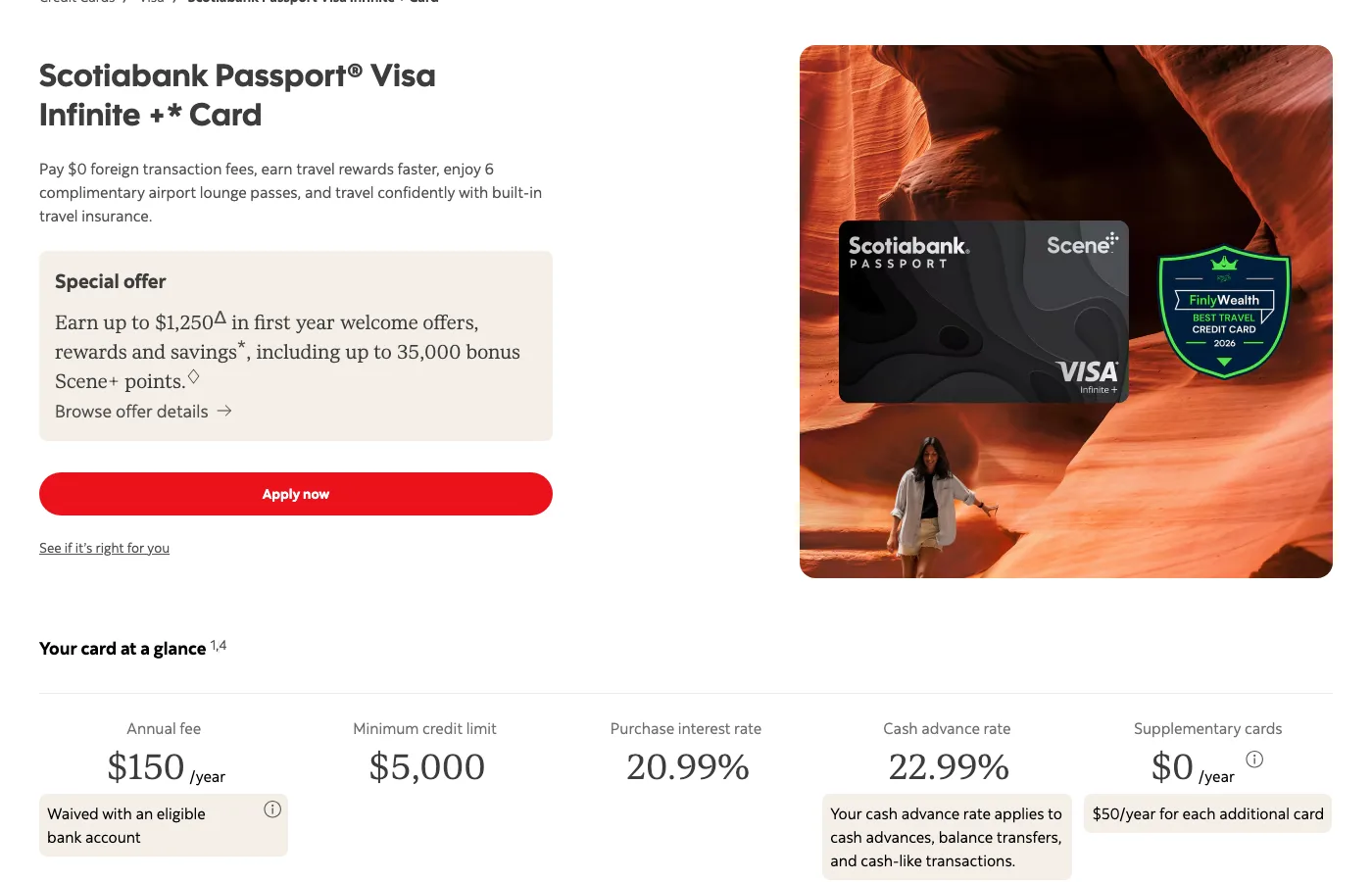
scotiabank.com, October 17, 2026. "Pay $0 foreign transaction fees" is the first line. Under the $150 fee, "Waived with an eligible bank account" means the Ultimate Package, which costs $30.95 a month unless you keep $6,000 in it.
I would not pick the Scotiabank Gold Amex for a trip. It has no foreign fee, but Amex is turned away at more places abroad than Visa or Mastercard, and a card that stays in your wallet earns nothing.
Two habits worth more than the card
- Pay in the local currency. When a terminal or a website offers to charge you in Canadian dollars, say no. The merchant then picks the exchange rate, and you can lose more than any card fee.
- Check a card's travel insurance before the trip, not after. It is the reason the Passport costs $150 and the Quicksilver costs nothing.
Every card above, sorted by what it keeps on foreign spending, is in the cards library under Abroad.
Before you apply: confirm the live offer on the bank's own page. Everything in this post is dated October 17, 2026, the day it was written, and banks change their offers whenever they like. General information, not financial advice, and no affiliate links. Full details in our Terms of Use.